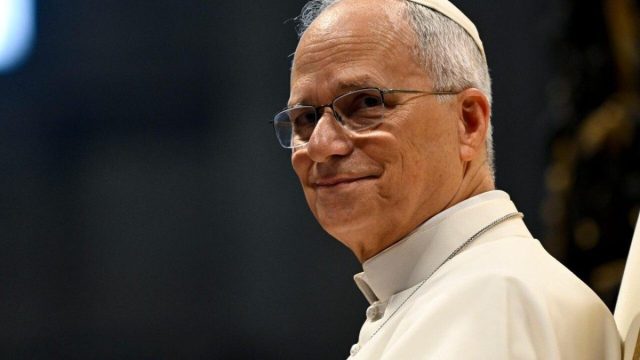
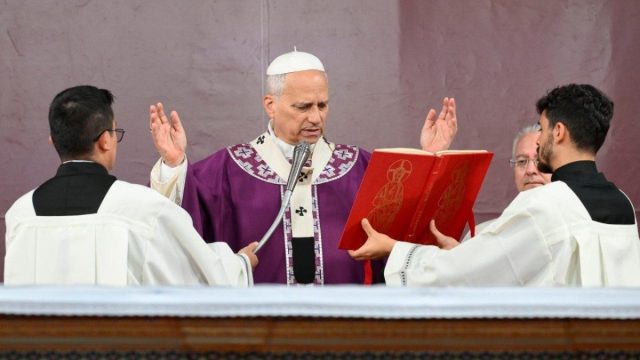
Pope Leo XIV ends Latin America trip with Mass for 1.5 million in Peru
Before the closing Mass of his 12-day trip to Uruguay, Argentina and Peru, the pope visited a home for the elderly in Callao, where a religious sister who knew him as bishop of Chiclayo was waiting
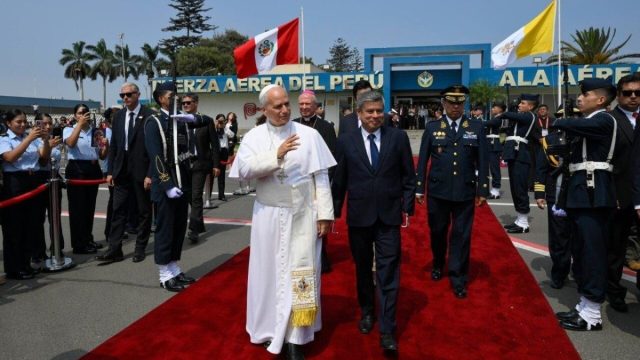
Pope Leo XIV ended his first apostolic journey to Latin America on Monday, November 16, with Mass at Las Palmas Air Base for 1.5 million people. The 12-day trip took him to Uruguay, Argentina and Peru, the country where he served for more than two decades. Before the Mass, the pope visited a home run by the Little Sisters of the Abandoned Elderly in Callao, Peru's port city next to Lima.
Reunion in Callao with Sister María Vázquez
The pope left the Apostolic Nunciature at 8:30 a.m. local time and went to the Little Sisters' home in Callao. When he arrived, the city's mayor, César Pérez, presented him with the keys to the city in a symbolic gesture. The home is the congregation's smallest in Peru. It has 60 residents and is run by a community of nine religious sisters, all of them Peruvian.
Among those waiting for him was Sister María Vázquez, who had known Robert Prevost when he was bishop of Chiclayo, in northern Peru. She told Alfa y Omega, a Catholic weekly published in Madrid, that the sisters invited him to consecrate the altar of the chapel at their home in Chiclayo three months after he was ordained a bishop. After that, he came at least twice a year to celebrate the Eucharist. "He was very approachable and welcoming, and he was always attentive to any need," she said. Vázquez met him again when Prevost served as apostolic administrator of Callao in 2020 and 2021, though pandemic restrictions then limited his visits to parishes.
Pérez told The Associated Press that during that period the then-bishop drove about 12 hours from Chiclayo to look after the home's elderly residents. He brought them food and supplies but did not enter the building, so as not to put the residents at risk.
"Such a tiny little house" turned into an oasis
Sister Agripina Garrido, a member of the congregation, said the sisters learned in August that Callao was among the possible stops on the papal trip. They thought it "impossible" that the pope would choose "such a tiny little house," she said. The confirmation came from the chaplain at the end of a Mass. He announced first that the pope was coming to Peru, then that he was coming to Callao, and finally that he would visit the home. "We were silent for a while, and then the applause started and nobody could stop it. The old people looked at each other, held on to each other, and some of them cried," Garrido said.
Since then, residents who had suffered from depression and barely spoke to anyone said they were so happy that, in their own words, "I can't contain myself." Silvia del Castillo, 84, who has lived in the home for three years, said: "When you're old and you have nowhere to go, and people open their hearts to you before they open their doors, you find happiness."
The pope had asked that only the sisters, the residents and the staff be present inside the home during his visit. The mother superior, an elderly resident and a longtime employee spoke to him, and then a couple of residents danced a marinera, a traditional Peruvian dance, for him. The congregation was founded in Spain in 1873 by Father Saturnino López Novoa and St. Teresa Jornet Ibars. Its motto, "care for bodies to save souls," guides the home's daily work.
The pope called the home an "oasis of dignity" and said there was an urgent need for more places like it, because "the ability to care for one another is a fundamental dimension of our humanity." He denounced situations in which "bodies receive neither care nor assistance and souls are not taken into account," where "the weakest and most defenseless are not protected but mistreated." He called for Peru to have "more oases of fraternity and fewer deserts of individualism," and said that "just as body and soul must be united for a human being to exist, the faith we profess needs to be united with the works we do."
The closing Mass at Las Palmas Air Base
From the home, the pope traveled to Las Palmas Air Base in Surco, a district of Lima. Crowds cheered him as his vehicle passed through the streets of Callao, chanting "The pope is Peruvian." At 10:30 a.m. he celebrated the closing Mass of the trip before a crowd of more than a million people.
In his homily, the pope recalled the promise of the risen Jesus in the Gospel, "I am with you always, until the end of the age" (Mt 28:20), and said the crowd gathered there bore witness that "the Lord lives continually in his Church and unites it." He said that "in a world wounded by arrogance, the word of God continues to teach us a new kind of strength: the power of crucified love." He prayed that God would help the faithful understand "the heart of the Church's mission: to carry on the work of Jesus Christ through his power, so different from worldly powers."
St. Toribio de Mogrovejo at the center of the homily
The pope devoted a central part of his homily to St. Toribio de Mogrovejo (1538-1606), the Spanish missionary he cited often throughout the visit. He recalled that Toribio, a layman with a law degree from the University of Salamanca and a promising legal career, received a "special invitation from Jesus" that took him by surprise. King Philip II of Spain put him forward as bishop of Lima, and the pope confirmed the appointment.
The pope described how the saint walked hundreds of kilometers across the country to reach Indigenous communities, learning their languages and trying to discern the silent action of the Holy Spirit. In Lima, he became known for his preaching and for his conviction, inherited from Bartolomé de Las Casas, that gentleness was the only way to proclaim the faith. He required priests to learn Quechua and fought for the ordination of Indigenous and mestizo men, who were then looked down on by much of the clergy. He also wanted Indigenous people themselves to evangelize their relatives and neighbors.
The pope quoted a biographer who wrote that "in his flock, the Indigenous person is the one who receives the greatest care. And it is mutual: they love him as if he were their father." Toribio gave nearly everything he owned to the poor and founded hospitals for Indigenous people. In tears, he would tell them: "O poor one, you make me rich! O naked one, you clothe me! O hungry one, you feed me!" After each pastoral visit, he compiled complaints and petitions about the situation of Indigenous people and sent them to the king, seeking an end to the injustices.
"The Peruvian people are also my people"
At the end of the Mass, the pope said goodbye to the country: "I wish to confirm you in faith and in charity, and to assure you that I will always carry you with me. Yes, the Peruvian people are also my people."
Peru's president, Keiko Sofía Fujimori Higuchi, led the official farewell ceremony on the runway at 1:15 p.m. Half an hour later, at 1:45 p.m. local time, a LATAM Airlines Boeing 787-9 took off for Italy. The flight, a little over 10,800 kilometers (6,700 miles) and about 15 hours long, was scheduled to land at Rome's Fiumicino airport at 10:25 a.m. on Tuesday, November 17.
A Peruvian menu on the flight home
For the occasion, the airline prepared a Peruvian-inspired menu with local chefs. Lunch offered two choices. The first was beef ribs with chocolate sauce, ripe plantain puree and hearts of palm, created by chef Aldo Yaranga of the restaurant AWA. The second was a version of arroz con pato a la chiclayana, the Chiclayo-style rice with duck that is a signature dish of the city where the pope was bishop.
Midway through the flight, passengers were served a rotisserie chicken sandwich on brioche, with chifles (plantain chips) from Piura, chocotejas (chocolate-covered sweets) and King Kong de manjar blanco, a Peruvian pastry filled with milk caramel. Before landing, breakfast included Peruvian fruit and three choices: an omelet with bolichoclo corn and vegetables, a board of local cold cuts and cheeses, or pan con chicharrón, a fried pork sandwich. The meal service also included fresh juices and Peruvian coffee grown above 1,600 meters (5,250 feet) in the Villa Rica and Huánuco areas.
The pope sat in seat 1C in the front row. The crew included four pilots and 11 flight attendants. An image of St. Toribio de Mogrovejo, who was canonized 300 years ago this year, was placed inside the aircraft, and the headrests carried the LATAM and Vatican logos.
Based on reporting by Almudena Buenadicha for Iglesia Noticias. This article was translated and adapted from Spanish with the help of artificial intelligence.