Pope Leo's visit challenges Peru's bishops on scandals, conference president says
Bishop Carlos Enrique García Camader said the pope's trip pressed Peru's bishops to face their own pastoral absences and the need to ask forgiveness for scandals in the Church
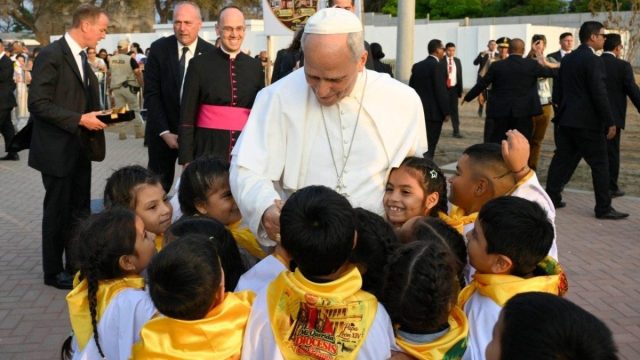
Bishop Carlos Enrique García Camader, president of the Peruvian Bishops' Conference, Peru's counterpart of the USCCB, said the speeches Pope Leo XIV gave during his visit to the country speak to the universal Church and also directly to Peru's own problems. Those problems, he said, are social inequality, political instability, violence, corruption and the exclusion of the most vulnerable.
García Camader said the pope knows Peru's history from direct experience, not from hearsay. Drawing on that closeness, he said, the pope offered three ways of tackling the country's difficulties: listening, attention to the pain of others, and dialogue. The bishop gave a personal example of how complex Peru is. He lives on the periphery of Lima and has talked with people living in the outlying districts that stretch for 80 kilometers (50 miles) around the capital who have never set foot in the city center.
Three moments from the meeting with the pope
García Camader singled out three moments from the bishops' meeting with the pope. The first was the way Leo opened his address. By greeting the prelates with the words "Excellencies, Eminences, brothers," he said, the pope immediately broke down the formal distance of protocol.
The second was St. Turibius of Mogrovejo, the 16th-century archbishop of Lima, whom the pope held up as a model of a pastor who stays close to his people, with no distance between them. The third was the pope's explicit acknowledgment that within the Church, too, there have been people in consecrated life who have brought scandal on the institution.
García Camader said the bishops must reflect on asking forgiveness on behalf of all pastors and others who have given cause for scandal or pain. He added that the pope stressed that bishops should not each work shut away in their own dioceses, but in communion and fraternity, moving beyond the logic of jurisdictional boundaries.
Pastoral absences and the need to listen
On the political crisis Peru has been living through for years, García Camader acknowledged that in the run-up to the papal visit there were meetings with people who feel no one listens to them. Some of them, he said, see the Bishops' Conference as part of the problem. He said what stayed with him was not what they said but the need they expressed to be heard.
Seen that way, he said, the pope's visit forces the Church to look in the mirror at its own pastoral absences and to build a program of trust that offers security and evangelizes.
Violence against women and minors
In Pucallpa, a city in Peru's Amazon region, Leo spoke about violence against women and minors, sexual abuse and the silence that covers up complicity. On those words, García Camader said the Church's existing listening and human dignity commissions should be expanded and made more visible. They should include trained professionals who offer not only a hearing but clear answers aimed at the truth and at a resolution.
He said that in the face of violence that in some cases seems to have become normal, the pope is calling for more intense work grounded in human dignity. He listed the areas where indifference can take hold: human trafficking, drugs, alcoholism, the absence of integral human development, poor health and corruption.
Next steps for the Bishops' Conference
Asked what concrete conclusions the conference will draw from the visit, García Camader said it will convene an assembly to study the pope's homilies and the pastoral challenges the visit has left. He said he would rather listen to his fellow bishops than anticipate decisions that belong to a body of more than 50 prelates.
García Camader also sketched a portrait of the pope drawn from his time in Chiclayo, in northern Peru. He described him as an Augustinian missionary who was close to people, a good listener and someone who walked alongside them, and as a bishop who was very active, practical and technical. His style was to give personal attention to each person he met, knowing them by name. García Camader also noted the pope's command of canon law and his collaborative work on the commission that listens to victims.
A gift of mercy for Peru
Reflecting on what it meant to him, as president of the Bishops' Conference, to welcome a pope who knows the country and has been part of the Peruvian Church, García Camader spoke of "an undeserved gift." Through it, he said, God in his infinite mercy has looked upon Peru to lift its spirits amid suffering, pain, deaths and conflict between brothers.
He said the work of reconciliation is still to be done and wounds remain to be healed, and that the pope is the sign that "they are not alone." Asked whether Peru already misses the pope, García Camader said that rather than nostalgia, the country feels joy and gladness, because it knows it has not lost him but has been enriched as a nation and as the people of God.
Based on reporting by Laura Clavería for Iglesia Noticias. This article was translated and adapted from Spanish with the help of artificial intelligence.