Pope Leo XIV tells young people at the Stade de France to choose the good
Speaking to thousands of young people at the Stade de France outside Paris, the pope answered questions on mission, vocation and freedom, and said the only weapon Christians carry is self-giving love
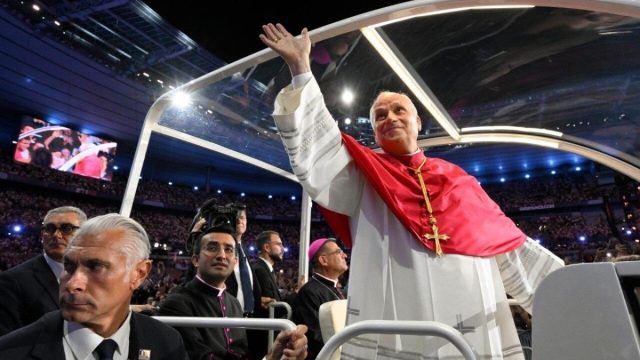
Pope Leo XIV addressed thousands of young people at the Stade de France, outside Paris. He answered questions on how to proclaim the faith while respecting those who do not share it, how to discern a vocation in uncertain times, and where to find freedom in Christ. The questions came from two young people, Chloé and François.
'For me, to live is Christ'
The pope built his address around the words of St. Paul that Chloé had quoted, "For me, to live is Christ." He said the phrase was not a passing remark but "a true summary of his life."
"In these few words, so brief and yet so decisive, we hear praise and prayer, an act of faith and a path of holiness followed all the way to martyrdom," he said.
"In repeating this declaration of love, we try to share the apostle's experience," the pope said. "He bears witness to how God is never a stranger to his life but, on the contrary, comes out to meet him: he calls him to himself, transforms him within and sends him into the world."
'The Lord is not indifferent to us'
Chloé had told the pope that "the society in which we live is based on other principles and at times seems even removed from the question of God."
"It is true, as you said, that the society in which we live seems indifferent to God. But the Lord is not indifferent to us! That is what counts, and it gives us hope," he replied.
"That many are strangers to the question of God is indeed a problem; but so is the fact that many are strangers to the question of man," the pope said. "How many people, sadly, take no interest in their neighbor and live selfishly, or despise the poor and waste their goods on trivial things. How many discard the simple and the sick, thinking that a person is worth what he produces."
He then turned to Chloé's work in Île-de-France, the region around Paris. "I think in particular of your commitment in the working-class neighborhoods of Île-de-France with La Cité Céleste: it is there, in the concreteness of daily life, and even in its difficulties, that your faith becomes a living witness of hope."
The Gospel and those who do not believe
Chloé asked how to proclaim Christ forcefully and with respect. The pope answered: "Proclaim him as the Gospel of salvation, as the Word of truth and of life. This Gospel is good news for everyone, a liberating proclamation and a rule of new life."
"The Gospel of Jesus does not lead to conflict, but always invites forgiveness: while it illuminates the drama of history, it teaches us fraternal care," he said. "The encounter with Christ opens us to dialogue and prepares us for his peace, because it offers every man and woman the greatest promise, which fulfills every desire: the promise of eternal life."
Citing the Second Vatican Council, the pope said that "in Jesus, the Redeemer of the world, God lets himself be found, speaking 'to men as friends.'" He added: "He is the source of living water, the light in the darkness."
On relations with people of other religions, he said: "Thanks to him we can unite missionary zeal with the experience of fraternity toward those who do not believe or who belong to other religious traditions. This fraternity, made up of listening and mutual esteem, is rooted in the unity of the human family, which throughout history has expressed the religious dimension as a vital feature of every people."
"Cultivating a fraternal bond with those who do not share our faith contributes to the building of society; it can also become an exercise of faith and charity, because it is impossible to bear witness to Christ without loving those to whom we wish to proclaim him," he said. He described "an encouraging sign of this fraternity" in "the meetings among young people of the Mediterranean area that have taken place in recent years."
Quoting the conciliar declaration Nostra aetate, he said the Church "rejects nothing of what is holy and true" in other religions.
Vocation, anxiety and the Eucharist
François asked about discerning a vocation in uncertain times. "It is often difficult to understand how to direct one's life so as to give oneself without reserve, with fidelity, without being scattered or discouraged, since the task at times seems immeasurable," he said. "Anxiety and uncertainty often make the enthusiasm of our youth fragile."
The pope said those feelings were widely shared, "because of the precariousness of plans for the future, the provisional nature of emotional bonds and the fragility of relationships." He added: "To these are added others that weigh on your generation, such as the weariness caused by screens and anxiety about climate change or the economic and international situation."
"This fragility, proper to human life, does not frighten us; it unites us as creatures who discover themselves to be brothers and sisters in Christ," he said. "He is the first to give himself to us, and the living sign of this grace is the Eucharist, 'source and summit of the whole Christian life.'"
"From this sacrament, which sustains our faith, we draw the strength to give ourselves in turn to our neighbor, imitating the gratuitousness of the Lord Jesus," he said. "The search for justice and peace obliges us to acknowledge the conflicts we ourselves experience and to purify our hearts. When we commit ourselves to the service of God and others, our wounds find consolation and redemption."
The pope told the young people: "In all of history, there is no failure from which God cannot raise us up: his mercy is our joy." He added: "I invite all of you, dear young people, to keep your hearts open to the sufferings of your companions."
"The experience of fragility, of any fragility, becomes for a disciple of Christ an occasion to be his witness," he said. Whoever follows Jesus "on the path of humble and freely given service is freed from anguish and rediscovers a new enthusiasm, experiencing interior joy and peace," he added, "not as fleeting or subjective feelings, but rooted in the certainty of the faith to which we bear witness together as Church."
"Yes, together we form the Church: fragile and holy, like earthen vessels that hold a treasure," he said. "It is again St. Paul who reminds us that precisely in weakness we are strong. Especially in difficult times, God sustains our freedom and encourages us with his grace."
Flee, strive, fight
The pope took up three verbs St. Paul addresses to Timothy.
"First of all, 'flee from these things,' that is, pride, vanity, violence and greed," he said. "They are all feelings that take hold of us and dominate us. The selfishness that marks them conceals a terrifying loneliness." That selfishness, he said, brings "a great many 'likes,' but leaves us alone with ourselves."
"To enjoy the closeness of God and human fraternity, it is therefore necessary to reject that greed which consumes relationships without giving anything in return and which fills us with things without nourishing us," he said. "That way of life pushes us to have everything, but to be nobody."
"Then we begin to strive toward 'justice, piety, faith, love, patience, meekness,'" the pope said. "Whoever lives from God strives toward what is better: he is in constant training. He seeks virtue, that is, the strength that makes him good and true."
"The dynamic that characterizes Christian existence has a precise name: it is called the path of holiness. It is the path the Lord opens before each of us, walking with us along the way," he said.
"And how many sons and daughters of this beloved land of France have let themselves be guided along this path!" he said. He named Blessed Marcel Callo, "a young Frenchman, a scout and a worker who, in the darkness of the concentration camp, never ceased to strive toward the good, preserving his interior freedom."
On the third verb, he said: "As we advance along this path toward holiness, it becomes clear that it is not enough to avoid evil: we must choose the good. This is not an abstract principle or an obvious statement: choosing the good is the proper act of freedom, and in carrying it out, freedom itself is fulfilled, corrected and brought to maturity."
"To make the right decision, remember this criterion: the good gives life, it never takes it away; the good cares, it does not take for itself," the pope said. "The good is not a pretty concept, but the radiant face of love: it is God himself!"
He linked this to France: "The principles of equality and fraternity that inspire your society find their foundation here: more than mere legal prescriptions, they are radical and courageous decisions of a free heart." He added: "To make these qualities our own is not only a moral commitment: it is the decision to become authentic men and women, free of compromises."
"This verb resounds strongly here in France, land of St. Joan of Arc, a young woman who knew how to fight with boldness," he said. "But take care: the fight to which we are called is that of faith, that is, the commitment to live according to the Gospel, as disciples of Jesus, the Son of God who makes us all brothers and sisters."
"It is in his name that we have the strength of the just to resist temptation. In his name we have the perseverance of the meek, to devote ourselves to the good," he said. "Our fight is not a battle against others; it does not resort to the weapons of violence, contempt or oppression. Our only weapon is love that gives itself."
The pope also spoke of "forces opposed to our bond with God, powers that seek to divide persons and peoples, setting them against one another." He said: "These evils do not only have a violent face; at times they also take on an insidious appearance, because they promise precisely what they take away from us: happiness." He added: "When we feel wrapped in their darkness, the light of the Holy Spirit enlightens and strengthens us."
French saints
The pope named St. Eugene de Mazenod and St. John Mary Vianney, priests he described as passionate for Christ; St. Thérèse of Lisieux; Blessed Pauline Jaricot, fervent in charity and mission; and 50 martyrs of the apostolate in the Second World War who served their brothers and sisters to the point of sacrificing their lives. "When life's decisions demand courage, turn to their intercession and imitate their example," he said.
"The saints changed the course of history, bringing many from suffering to hope, because they first changed their own hearts, transforming them in the light of faith," he said.
Discernment
"Dear friends, this friendship with Jesus is where our discernment takes place, a reflection that requires calling on the Holy Spirit. It is a constant exercise, so as to move forward in an orderly and secure way," the pope said.
"First of all, remember that the Word of the Lord is always a lamp for our steps," he said. "In the light of the Gospel, spiritual formation passes through prayer and service; adoration and action; silence, that silence so rare and so necessary, far from the noise of the media, and proclamation."
"Then, look at the example of the saints," he said. "Even under persecution, these brothers and sisters of ours opened paths of peace."
"Dear young people, as you discern your vocation, be sure that the Lord does not speak to you in a confused way, but addresses each one by name and invites you to follow him because he loves you," the pope said. "Welcoming his Gospel with a clear mind and a pure heart, you will understand how Jesus is calling you to serve. It is always a gift of life: full, faithful, overflowing with love."
"To overcome anguish or uncertainty, have the courage to say a single word, simple and beautiful: thank you. Thank you, Jesus, for your love," he said. "So now, without fear, but with confidence and full of joy, we can all say together, following in the footsteps of the saints: 'Here I am, Lord!'"
He then addressed "those among you, and there are many here tonight, who believe they hear the call to follow Jesus on the path of the priesthood or of consecrated life."
"Dear friends, the Church in France needs you greatly! She prays for you, she is waiting for you," he said. "Dear friends, do not be afraid of this call! Take courage, trust in Jesus, who wants to make you his closest friends. He will not disappoint you and he will always be at your side; your life will be wonderfully beautiful and fruitful."
Evening meditation
In the evening meditation, the pope said: "God is the Lord of history and, whatever happens, he leads it toward salvation: in Christ every evil has an end, precisely because the end becomes the beginning of a new and eternal life."
"To shed light on our times and transform the present in the light of the Spirit, let us remember above all that we too, like Timothy, are men and women of God," he said. The expression, he added, "refers to a relationship, not a possession." "Whoever lives from God is free: free from everything that darkens life, making it empty and meaningless."
"Young people of France, you carry in your hearts an immense desire for freedom, a word that resounds strongly in your culture. What, then, is the source of true freedom?" he asked. "Jesus shows it to us clearly when he tells us that the truth will set us free, and that he himself is the Truth. Here, then, is the source of true freedom: a living relationship with Jesus."
"The company of the Lord gives wisdom to our plans and beauty to the desires we carry in our hearts," he said. "God passes through our soul like light, calling us to a permanent renewal, to a conversion that gives full meaning to existence, because it makes us protagonists of a history that moves from confusion to the search for truth, from indifference to commitment to justice."
He asked the young people to pray to St. Thérèse of the Child Jesus "to teach us her 'little way' of daily love, the solid foundation of all lasting peace."
"The Lord makes this peace a reality through the Covenant he establishes with all of us in Jesus Christ," he said. "St. Paul speaks not only of what we can do in responding to God, but also of what God does for us. The apostle sums it up in one episode: Jesus before Pilate, the truth of love before the hypocrisy of power." He added: "The 'good fight' therefore coincides with the 'beautiful testimony.'"
The tunic and the cross
The pope closed by pointing to two relics present at the gathering. "Let us contemplate the two relics before our eyes: the tunic and the cross. One was taken from Christ; the other was given to Christ. In this sense, both are signs of his passion."
"Jesus is stripped of his tunic to clothe us with the white garment, washed 'in the blood of the Lamb,'" he said. "This is how the cross, from an instrument of death, becomes a sign of hope: together, then, the tunic and the cross represent us," he said, "us, the Church born of the life of God given to the world."
"Dear young people, to grow in holiness and improve our society, be luminous witnesses of this Gospel, that is, of the good news who is Christ himself, our Savior: 'To him be honor and eternal power. Amen.'"