Spain's Cardinal Cobo calls for more lay involvement in choosing bishops
Cardinal José Cobo Cano, archbishop of Madrid and a member of the Vatican's Dicastery for Bishops, told a forum in Barcelona that files on candidates can run to 800 pages and that many requests for reports go unanswered
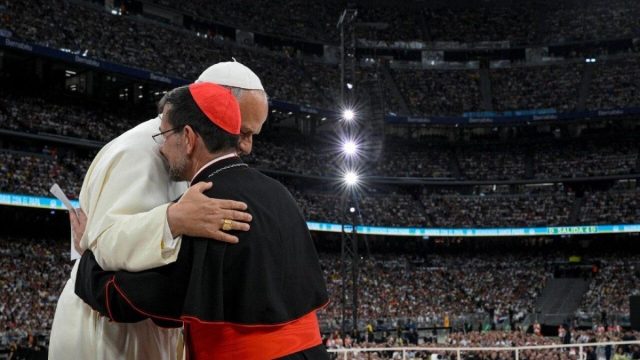
José Cobo Cano, cardinal archbishop of Madrid and a member of the Dicastery for Bishops, explained in Barcelona on October 15 how the Catholic Church goes about appointing its bishops. He was speaking at the Tribuna Joan Carrera, a forum convened by 26 organizations to discuss the challenges of synodality. The question reached him in writing from the audience, and he asked for enough time to answer it in the detail he said it deserved.
A communal discernment, not an election
Cobo ruled out any comparison with electoral politics from the start. "Choosing a bishop is not simply a parliamentary election," he said. He described the procedure as a double discernment: that of the community that needs a pastor, and that of the Church as a whole, so that a diocese does not turn in on itself. In that framework, he said, Peter's role is to harmonize the different particular churches.
Collecting the names put forward is the job of the nuncios in each territory, and the candidates are not limited to the diocese concerned. "For the archbishop of Madrid they do not only propose or ask in Madrid, they ask in other places too," Cobo said. The nuncio then draws up a table recording how many times each name has been mentioned and what objections each candidacy raises.
Hundreds of pages of reports
All of that material becomes a sizeable file before it reaches the dicastery. Cobo said some of the dossiers handled there run to 800 pages. He estimated that a small diocese can generate up to 80 initial reports, with a second round of consultations when the result is judged insufficient.
Those consulted include the diocese's governing bodies, the most representative groups in the community, the ecclesiastical provinces and the sees where the candidate has served before. The number of testimonies rises sharply when the consultation reaches several levels of Church life.
Summaries, three-name lists and the pope's decision
Inside the dicastery, which has 18 members, a rapporteur summarizes each candidacy by cross-checking the assessment of those closest to the candidate, that of people outside his circle and that of the nuncio. From that work come the ternas, the lists of three names sent to the pope. Cobo defended the secrecy that surrounds the whole procedure: "the fact is we are talking about people's lives."
He also set out the criteria that guide the reports: they do not assess leadership or personal brilliance, but the pastoral ability to accompany a Christian community. Asked about timing, he said the final decision belongs to the pope, who takes it once the whole process has been completed.
The gap in lay participation
Cobo said plainly where he sees the main shortcoming of the current mechanism. "What we need most, and it is what we are asking for, is more lay involvement," he said, and he acknowledged that equal participation between lay people and ordained ministers remains an aspiration that has not been reached. Part of the reason, he said, is that a significant number of requests for reports go unanswered.
The procedure has been under continuous review for years, and he said he has seen changes himself during the two and a half or three years he has been at the dicastery. He noted that Pope Leo XIV headed the same body for three years, so he knows its limitations first hand, and that the pope has already begun to make changes.
Asked about the large number of Spanish sees still waiting to be filled, he joked about opening a department devoted solely to Spain. On Barcelona, he said only: "I know that I hope the pope will present you with a magnificent bishop."
Synodality: an old novelty written into Pentecost
Cobo's earlier lecture had been on synodality, which he defined as an old novelty written into the Church's DNA since Pentecost. He used two images: the violinists on the Titanic, playing with mastery while the ship goes down, and the prophet Jonah, who needs to convert after Nineveh does.
From there he drew the central question of his proposal: to stop asking what must be done and ask instead what God is doing. He built the argument around four ideas, the people of God, baptism, mutual need and shared discernment, and condensed it in a formula he repeated several times: "No one is superfluous, but no one is enough."
Differentiated co-responsibility, he said, does not come from a delegation or an assignment but from baptism itself. He then set out six specific challenges: restoring a solid baptismal culture; moving from mere collaboration to mutual need; building decisions together; attending to real people instead of working with abstract categories; replacing polarization with polyphony; and forming missionary disciples.
On the exercise of authority he was explicit: "Not all of us have to decide everything, but no one should decide alone what we need to discern together."
Madrid: building a participatory culture
Cobo listed steps already taken in the Archdiocese of Madrid: eight pilot centers for the adult catechumenate; pastoral councils written into the statutes, which canon law does not require; and the creation of a lay coordinator post in each of them.
He acknowledged that both initiatives met resistance. He also called for a revision of canon law along synodal lines, which he described as urgent to give legal support to the structures the Church is trying to promote.
Convivium: a gathering of 1,300 priests
Cobo devoted the last part of his remarks to an experience called Convivium, a meeting held in preparation for the Madrid diocesan assembly in which 1,300 of the 1,800 priests serving in Madrid took part. The groups were organized by age bracket, not by vicariate or area of work.
The outcome surprised the cardinal himself: the priests did not ask for new documents or extra structures. Priests of very different sensibilities who had never met asked to be photographed together at the same table. "The Church is the bond," he said.
Along the same lines, he announced an upcoming assembly of young people using the method of conversation in the Spirit. Asked about the peripheries, he rejected the idea that life on the frontier should be seen as wearing people down, and said he knows of no situation of exclusion without a Church presence. "Charity is what is going to save us," he said, warning that the day the Church abandons that care it will stop being the Church.
Women and political polarization
On the role of women in the Church, Cobo summed up his position in two phrases: "we have to get our act together" and "we have to change the score."
The discussion also led the cardinal to speak about Spanish politics. Asked about polarization in Spain and the possibility of the far right coming to power, he said: "Yes, I think it frightens me, frankly."
He then spoke of what he called the disarmed and disarming word, a phrase he attributed to the pope. He recalled the pope's speech in Parliament and the image of the skylight that crowns the Congress of Deputies, the lower house of Spain's parliament. He drew a line: debating ideas is legitimate, but the problem comes when political language becomes a tool for annihilating the person. That, he said, is a red line Christians should not tolerate.
He recalled that the Church has acted at other moments in history as a space for consensus and dialogue, and said that role is particularly urgent again in a society as fragmented as today's.