Pope Leo XIV requests mail-in ballot for US midterm elections
The pope, registered to vote in Illinois under his civil name, Robert Francis Prevost, asked for a mail ballot for the November 3 midterms and would be the first pope to vote in a US election. His request comes amid public tensions with Donald Trump
Pope Leo XIV has requested a mail-in ballot for the November 3 midterm elections in the United States. The Chicago Sun-Times first reported the request, and the Will County election office, in the Chicago metropolitan area in Illinois, confirmed it. The pope is on the voter rolls under his civil name, Robert Francis Prevost, at the home of his brother John in New Lenox.
Prevost, born in Chicago in 1955, filed the request on October 3. There is no record so far that he has returned a completed ballot. If he does, he would be the first pope on record to vote in an election.
A voting record with no clear party affiliation
Before his election as pope in May 2025, Prevost voted in the 2024 presidential election that returned Donald Trump to the White House. He also voted in three general elections: 2012, 2014 and 2018. Will County records also show that he voted in the Republican primaries of 2012, 2014 and 2016 and in the Democratic primaries of 2008 and 2010. In Illinois, any voter may choose which primary to vote in without registering with a party, so the records do not indicate a clear ideological preference.
Open differences with Trump on foreign policy and immigration
Leo XIV has not criticized the Trump administration directly and publicly, but he has openly rejected the war waged by the United States and Israel against Iran, which he called "unjust." He has also questioned Trump's immigration policy in veiled terms. He called for "deep reflection" on the treatment of migrants in the country and said there are people who have lived there "for years and years without causing problems who have been deeply affected."
The pope has asked all sides to sit down and negotiate an end to the conflict. In May he urged citizens of every country involved to contact their authorities and their representatives in parliament to ask them to work for peace and always reject war.
Trump criticizes the pope
In April, Trump publicly accused the pope of being "weak on crime and terrible on foreign policy." He did so on his Truth Social network, after Leo XIV criticized Trump's threats to wipe Iranian civilization "off the map." In a long message, the president wrote: "We don't like a pope who says it's OK to have nuclear weapons. We don't want a pope who says crime is OK in our cities. I don't like it. I'm not a big fan of Pope Leo."
In the same post, Trump said he did not want a pope who "thinks it's OK for Iran to have nuclear weapons. I don't want a pope who thinks it's terrible that the United States attacked Venezuela, a country that was sending enormous quantities of drugs to the United States and, worse still, releasing murderers, drug traffickers and criminals into our country."
The president went further, writing that "the pope is weak on crime and terrible on foreign policy. He talks about the 'fear' of the Trump administration, but he doesn't mention the fear the Catholic Church felt during the pandemic, when priests were arrested for celebrating Masses, even outdoors and at a safe distance."
Trump added that he likes "his brother Louis much better, because he's a real MAGA follower. He gets it, and Leo XIV doesn't!" He closed with a claim about why the pope was elected: "Leo XIV should be grateful because, as everybody knows, he wasn't on any list to be pope, and the Church put him there only because he was American, and they thought that would be the best way to deal with President Donald Trump." He finished: "If I weren't in the White House, Leo XIV wouldn't be in the Vatican."
The pope's response
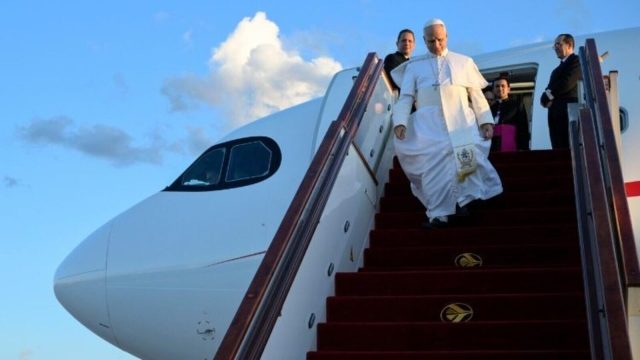
A few hours after Trump's comments, Leo XIV answered reporters' questions on a flight to Algeria. "I do not consider my role to be that of a politician, I am not a politician, I do not want to get into a debate with him," the pope said. He added: "I do not think the message of the Gospel should be abused as some are doing."
The pope said he would keep "raising my voice against war, trying to promote peace, encouraging dialogue and multilateralism with states to look for solutions to problems," because "too many people are suffering today, too many innocent people have been killed and I think someone has to stand up and say there is a better way."
His message, he repeated, "is always the same: peace." "I say it for all the world's leaders, not just for him: let us try to end wars and promote peace and reconciliation," he said. Asked the same question by another American journalist, Leo XIV said: "I am not afraid of the Trump administration. I will go on speaking out about the message of the Gospel, which is what the Church works for."
On the voter rolls in another country
This is not the first report about the pope and an election. Peru held regional and municipal elections on October 4, and local media reported that Leo XIV was listed as a voter at a polling place in the city of Chiclayo, where he served as bishop. The National Registry of Identification and Civil Status (Reniec) said this is because the pope retains his Peruvian citizenship.
In Peru, voting is both a right and a legal obligation for most citizens. The law makes it optional rather than compulsory for those over 70. The pope passed that age a few months after his election.
Based on reporting by Juana Morales for Iglesia Noticias. This article was translated and adapted from Spanish with the help of artificial intelligence.