Christians targeted in 70 percent of religious attacks in Spain, observatory tells OSCE
Spain's Observatory for Religious Freedom and Freedom of Conscience told an OSCE conference in Warsaw, before representatives of 57 states, that the country's figures on religious attacks are skewed and that Christians suffer seven of every 10 incidents
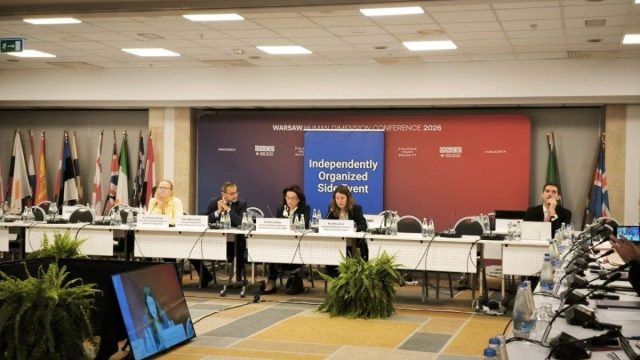
The Observatorio para la Libertad Religiosa y de Conciencia (Observatory for Religious Freedom and Freedom of Conscience) has taken a complaint to the Organization for Security and Co-operation in Europe over what it calls the manipulation of data on religious attacks in Spain.
The observatory's president, María García, spoke at the Warsaw Human Dimension Conference 2026, before representatives of the 57 participating states and many civil society organizations. She said Christians are the target of 70 percent of the incidents the observatory documents, while the Spanish government deliberately omits that category from its official records.
"This government does it for ideological reasons," García said, adding that "the new government that emerges after the November elections has a fresh opportunity to consider it."
306 attacks recorded in 2025
The observatory presented figures from its latest report on attacks against religious freedom in Spain, which documented 306 cases in 2025, the highest number since it began tracking them in 2012. That is 26 percent more than in 2024 and 57 percent more than in 2023.
Christians were the victims in 70 percent of the incidents, or 214 cases. The report also lists 40 attacks against Jewish people or communities, 26 against Muslims and 11 against Jehovah's Witnesses. Attacks on places of worship and religious symbols rose 60 percent, to 73 cases.
Official records
García told the state representatives that government records discriminate deliberately. "The Spanish government, in its report on hate crimes, distinguishes between Islamophobia and antisemitism. But it includes cases of Christianophobia under the generic label 'against religious beliefs,'" she said.
"At the Observatory for Religious Freedom we see, year after year, that these are the most numerous cases. And we believe this government does it for ideological reasons. Once again, we ask them from here, as the OSCE has also asked them, to record hate crimes against Christians by name," García said.
Two roles in Warsaw
The observatory did more than speak at the conference. With other European associations, it co-organized the roundtable "Hate crimes and freedom of religion or belief in the OSCE region," which looked at responses to anti-religious intolerance in multi-faith settings. García also spoke at the roundtable "Combating discrimination against religious communities in the digital age," organized by Italy's Permanent Mission to the OSCE.
Artificial intelligence
García warned that the line between hostility online and its consequences in real life is increasingly blurred. The observatory has documented cases in Spain in which material spread through the media and on social networks led to direct harassment of people over their religious beliefs.
García also raised the use of artificial intelligence to manipulate religious images, which has been notable around the Holy Week confraternities. "Algorithms and artificial intelligence do not create religious intolerance on their own, but they can hugely multiply its reach and its consequences," García said.
Three priorities
The observatory has set out three priorities.
First, better communication among religious communities, civil society, digital platforms and law enforcement. Second, statistics that properly distinguish between the different kinds of religious intolerance, dropping the generic categories that hide specific forms of persecution. Third, greater transparency and accountability from digital platforms over content that incites intolerance.
The Observatory for Religious Freedom and Freedom of Conscience regularly takes part in national and international forums to draw attention to violations of religious freedom and to put proposals to institutions on how to protect it better.