Cardinal Vesco calls for binding structures that require bishops to listen to the faithful
In an interview with the Belgian Catholic outlet CathoBel, Cardinal Jean-Paul Vesco, archbishop of Algiers, said the synodal process has made lay participation irreversible and called for binding mechanisms that would require bishops to listen to the faithful
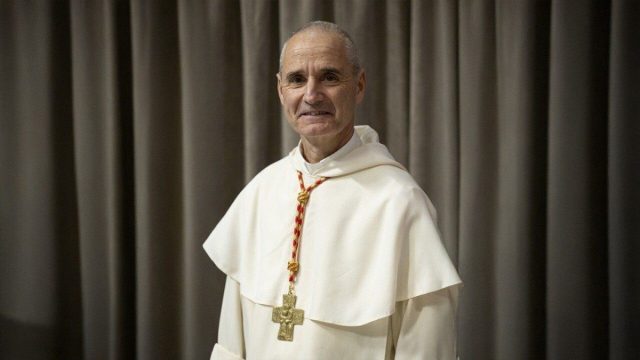
Cardinal Jean-Paul Vesco, the archbishop of Algiers, Algeria, gave a long interview to journalist Christophe Herinckx for the Belgian Catholic outlet CathoBel, published on October 23, 2026, according to religiondigital.org. In it he sets out his reading of the new pontificate, reflects on Christian life in Algeria and argues that fraternity should be the central criterion both for the Church's presence in society and for the way bishops exercise authority. Vesco summed up the difference in style between Francis and Leo XIV in a single sentence: "Francis's strength was his unpredictability and Leo's strength is his predictability."
For the Dominican cardinal, that difference in temperament does not amount to a change of course. In his view the new pope continues the direction his predecessor opened in relations with the world, the peripheries and other religions, but governs differently. Vesco, who took part in the conclave and got to know Robert Prevost during the general congregations beforehand, described him as a man who is "simple and humble," able to listen and to decide. His sense of the mood was that a large majority of cardinals wanted continuity in direction but a different style of governance, and that this is what is happening.
Respect for the institution as a force for change
The cardinal also drew a distinction between the way Francis and Leo XIV relate to the institutional Church. The Argentine pope sought to step outside his own constraints, he said, while Prevost works from within the structure without losing his freedom. In Vesco's words, "Leo respects the institution and, because of that, will be respected by it, which will give him a greater capacity to transform it." He added that the new pope's most important task will be played out not inside the Church but before the world.
On Leo XIV's visit to Algeria, Vesco said he sensed from the start that the real reach of the trip would become clear only once the pope had left. The pope was received as a major world figure, but a close one, Vesco said, and his words were apt, courageous and kind. It was essential for Vesco that the trip not be reduced to an internal event for the Catholic community, and that the Algerian people as a whole feel visited. The line he keeps as a symbol of that effect came from a woman watching the plane take off: "I had the impression of seeing a friend leave."
A mosaic Church in Algeria: rooted and open
The Catholic community Vesco leads in Algeria includes people of some 30 nationalities. He called it a mosaic Church that has to hold together two things at once: roots in the country and openness to the universal. Without the first, it becomes a foreign Church; if the second is ignored, it becomes merely a national one. Vesco rejected any temptation to proselytize and described the community's vocation as being one more part of the Algerian people, not a body aimed at conversion.
After almost 25 years in Algeria, the cardinal questioned the idea that every conflict between communities can be explained by religious difference. Dialogue, he said, should not be framed in religious terms, because differences of faith are usually exploited against a background of unresolved historical wounds. He also rejected the view that belonging to Islam is incompatible with democratic aspirations, and asked Christians to choose between seeing themselves as a besieged fortress and opening themselves to fraternity.
Synodal process closes the door on councils of bishops alone
The sharpest part of the interview deals with power inside the Church. Vesco said the synodal process has widened lay participation to a point he considers irreversible, and said it has closed off any possibility of imagining a future council made up only of bishops. His proposal goes beyond trusting in the goodwill of bishops: he called for structures that require them to listen to the faithful, binding mechanisms that make that listening an obligation rather than a voluntary gesture.
A bishop today holds all three powers, judicial, legislative and executive, in a role close to that of an absolute monarch, he said. Vesco asked openly whether binding bodies should be created to make listening to the faithful a real requirement. He drew on his experience as a Dominican provincial superior, where authority is exercised within a framework of shared responsibilities. Those limits, he said, take nothing away from the superior's authority and may even strengthen it.
An open fraternity as his dream for the Church
He applied the same logic to the handling of abuse cases: a bishop should not personally conduct the investigation on which he will later base his decision, but should rely on specialized services. His argument comes down to one sentence: "What is lost in power is gained in authority."
Asked at the end of the conversation about his dream for the Church, Vesco offered not a program of reforms but an image of relationship: that a Catholic could be recognized by the way he is a brother. That fraternity, he said, is not life without friction, but a disposition that keeps difference from becoming a reason for exclusion and that requires recognizing the same dignity in the person who is different. "I would dream of this being said of the Church, of Christians, of Catholics: they live a fraternity open to all."