Cardinal Parolin says a child is a gift, not a right, at Rome fertility congress
The Vatican secretary of state opened a three-day international congress on fertility and infertility at a Rome university, rejecting the reduction of procreation to a technical result and saying it is rooted in conjugal love
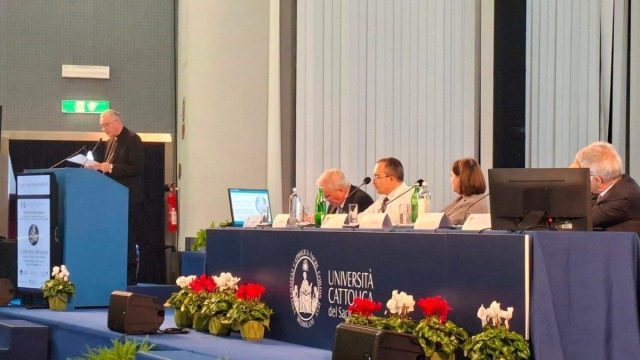
Cardinal Pietro Parolin, the Vatican secretary of state, opened the international congress "The splendor of the human: safeguarding fertility, curing infertility" on October 16 at the Catholic University of the Sacred Heart in Rome. The congress ran through October 18. In a talk titled "The dignity and beauty of procreation in the Magisterium of the Church," Parolin started from an anthropological premise: men and women are "willed by love, created to love," and educating the heart is the primary purpose of human life.
In a long address, Parolin went through Church teaching from the Second Vatican Council to the documents of St. Paul VI, St. John Paul II, Benedict XVI and Francis. He spoke about the duty to protect the dignity of every life, the role of parents as educators and the value of marriage between a man and a woman as the foundation of the family.
Conjugal love, the root of procreation
Taking St. John Paul II's apostolic exhortation Familiaris consortio as his starting point, Parolin said genuine love is not exhausted in feeling. It involves a free and conscious choice that shows itself in self-giving, care for the other and openness to life. Conjugal love, he said, is an "eminent and significant" form of love, directed toward mutuality, fidelity and fruitfulness.
That fruitfulness is not reserved to marriage, Parolin said. Those who embrace consecrated life, even though they give up physical fatherhood or motherhood, "become spiritually fruitful, fathers and mothers of many." He also cited the conciliar document Gaudium et spes, which presents marriage above all as "an intimate partnership of married life and love" and sets it apart from mere erotic attraction.
Procreation versus technical reproduction
St. Paul VI's encyclical Humanae Vitae was central to Parolin's talk. He noted that the text describes conjugal love as "human, total, faithful and exclusive," and that its horizon does not end with the communion between the spouses but points to the generation of new lives. He also cited Pope Francis's exhortation Amoris Laetitia, which ties the origin of a human being to a procreation rooted in the union, not only biological but also spiritual, of parents joined in marriage.
Against what he called "the so-called culture of separation," Parolin rejected any reductionism that turns procreation into a merely technical or biological result. That reductionism, he said, has meant that "procreation has increasingly become reproduction, distancing itself not only from conjugal love but also from the sexual relationship." He recalled that Francis warned in his writings that the biotechnological revolution "has introduced the possibility of manipulating the generative act, making it independent of the sexual relationship between man and woman."
For Parolin, bringing a new life into the world involves the whole person and finds its meaning in conjugal communion. A child, he said, is not a service that can be demanded but a gift that calls for gratitude and responsibility.
Responsible parenthood and natural methods
Parolin devoted part of his address to responsible fatherhood and motherhood. Family decisions, he said, require dialogue between the spouses, mutual respect and attention to personal dignity, in the light of the Magisterium. He defended natural methods of regulating fertility as a way for couples to learn more about their own bodies and to deepen the quality of their relationship.
Humanae Vitae, he said, "emphasizes the need to respect the dignity of the person in the moral evaluation of methods of birth regulation," and that choice must be shared by the spouses until it becomes "their common patrimony and a way of life."
Welcoming life and support for families
Parolin called for a culture capable of welcoming every child, including when a birth comes with difficulties or when the child has a disability. The Church, he said, wants to support families going through times of vulnerability, offering them help and encouragement. Parental love can also go beyond the biological bond, he said: adoption and guardianship are concrete expressions of solidarity that open a home to children who have been abandoned or who face serious hardship.
Parents' responsibility does not end with birth, Parolin continued, but carries on in the work of education. The family is called to be the place where every person is recognized in his or her dignity. Educating means supporting children as they mature, guiding them toward the good and preparing them to exercise freedom responsibly. Parolin said that "a mother and a father" should be "always present in every circumstance," because their duality and complementarity also show in their relationship with their children.
He spoke of the importance of a "heart that sees," able to notice the needs of others and to act on them. That concrete attention, he said, makes it possible to live the fruitfulness of love even for those who cannot have children, through work in education, closeness to other families and service to the most vulnerable.
Science at the service of natural procreation
Closing his address, Parolin thanked those who work in research and in the formation of couples so that they can fully live the procreative dimension of conjugal love. He singled out the International Scientific Institute Paul VI, which is committed to medical research aimed at natural procreation.
Science, he said, should concentrate on preventing and treating the causes of infertility, giving couples the possibility of bringing a new life into the world with full respect for the dignity of the parents and of the unborn child. The congress, Parolin said, is both a recognition of the work already done and a sign of hope, encouraging everyone to "continue this path with renewed commitment in the service of human love and procreation."