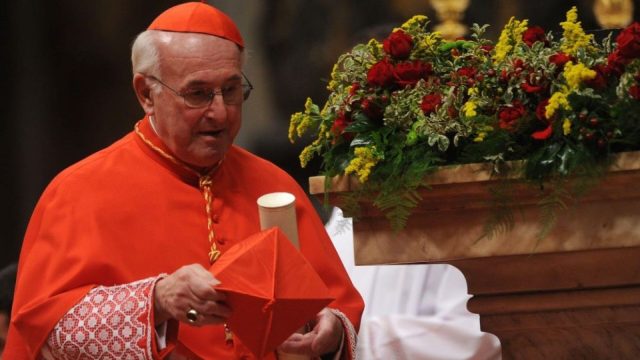
Cardinal Brandmüller says synodality is partly inspired by Protestantism
Cardinal Walter Brandmüller, 97, criticized the lack of a clear definition of synodality and warned about the influence of secular structures in the Church

Cardinal Walter Brandmüller, a Church historian, said he is concerned about the approach to synodality now being promoted within the Church and that it is partly inspired by Protestantism. In an analysis published by the Vatican journalist Sandro Magister, the 97-year-old German cardinal discussed the implications of the way the Church is governed today and warned that synodal gatherings risk being corrupted.
Brandmüller said there is still no clear and precise definition of the term "synodality," which he said has caused confusion about how it is applied. In his view, a synod has traditionally meant "a meeting of bishops to jointly exercise their magisterial and pastoral service."
Criticism of the current synodal structure
The cardinal criticized the way the Synod on Synodality is organized, with both lay and clerical voting members, and said such a body cannot be considered a true synod. "Neither priests nor laypeople can exercise the magisterial and pastoral ministry that is conferred on bishops alone through the sacrament of holy orders," he said. He warned that this could lead to a desacralization of the Church, because such gatherings come from an uncritical attempt to import secular structures and democratic procedures into the life of the Church.
Brandmüller said the spread of meetings of this kind is turning the Church away from its traditional way of convoking synods and toward a model that resembles Protestantism. "A type of synod is being proposed in the Catholic sphere, inspired in part by the Protestant model, whose members are democratically elected from among pastors, men and women of various professions and cultural backgrounds, all with an equal voice," he said.
Comparison with the Protestant Reformation
The cardinal compared this development to the Protestant revolution and to Martin Luther, who argued for lay participation in Church decisions. "It is evident that such a concept of synodality is incompatible with Catholic ecclesiology," Brandmüller said. He also warned about the negative consequences in the Church of adopting secular decision-making styles, citing the development of bishops' conferences as an example.
Secularization of the Church
As bishops' conferences have grown in size and standing, Brandmüller said, they have replaced synods and become more political, which he said reflects a growing secularization of how the Church is understood. He said an "ecclesiological neo-Arianism" can be seen in the modern style of bishops' conferences, one that does not expressly deny the supernatural character of the Church but largely ignores it, reducing the Church to a social entity.
He called for synods to be restored to the particular churches, which he said would give them back their original importance and help counter the secularization of the Church. Brandmüller has twice joined other cardinals in submitting dubia to Pope Francis: first in 2016 concerning Amoris Laetitia, and again in 2023 on the Synod on Synodality.