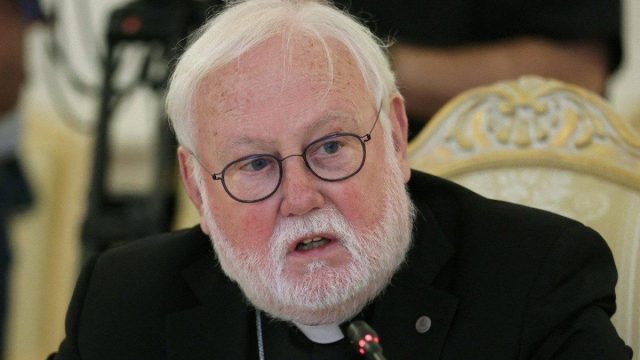
Brother of slain Pakistani minister urges West to press Islamabad on Christians
Peter Bhatti, the older brother of Shahbaz Bhatti, the Pakistani minister for minorities killed for his Catholic faith, told the launch of an Aid to the Church in Need report at Britain's Parliament on October 27 that Western governments are not doing enough to protect religious minorities
Peter Bhatti, the older brother of Shahbaz Bhatti, the Pakistani federal minister for minorities who was killed for his Catholic faith, called on Western governments on October 27 to increase diplomatic pressure on Islamabad to protect religious minorities. He was speaking in London at the launch of the 10th edition of the report "Persecuted and Forgotten? A Report on Christians Oppressed for their Faith 2024-2026," produced by the pontifical charity Aid to the Church in Need (ACN). The event was held at Portcullis House, part of the British parliamentary estate.
"Neither the UK nor any other Western government is doing enough for the persecuted Christians of Pakistan. No country has done what is needed to protect religious minorities, especially Christians," he said. The West should promote interreligious harmony in Pakistan so that people can live together, he said, and that will not happen while Western governments avoid serious talks with the authorities in Islamabad. Bhatti called on the United Kingdom to join the United States, the European Union, Canada and other nations in pushing for a common strategy to combat the oppression of minorities because of their faith.
The legacy of Shahbaz Bhatti
Bhatti wrote the foreword to the report because 2026 marks the 15th anniversary of the murder of his brother Shahbaz, who was shot in an ambush outside their mother's house. The minister had campaigned for reform of Pakistan's blasphemy laws and for the release of Asia Bibi, a Christian woman sentenced to death after a false accusation. Bibi was eventually pardoned and now lives in exile in Canada. Shahbaz Bhatti has been recognized as a martyr, and the Diocese of Rawalpindi-Islamabad opened his canonization cause in 2016.
No improvement in Pakistan
At the launch, Bhatti said the position of religious minorities in Pakistan has not improved at all. Many human rights and religious freedom advocates have chosen to stay silent for fear of becoming targets of extremists, he said, leaving minorities more exposed. He listed the consequences as abuse of the blasphemy laws, abductions, forced conversions and forced marriages. "The situation of religious minorities keeps getting worse," he said, and he urgently called for greater public awareness of it.
The 42-page report examines the persecution of Christians in 18 countries over the past two years. None of the 18 countries recorded any improvement for persecuted Christians. In 10 of them the situation worsened, and in the other eight it remained just as serious. Pakistan is among the countries where persecution has worsened. The report notes that in April 2026 United Nations experts expressed "grave concern" about abductions, forced conversions and forced marriages of women and girls from Christian and other religious minority communities.
Abductions of women and girls
Estimates cited in the report say there could be up to 2,000 abduction cases a year in 2025, with victims subjected to physical and sexual abuse. Open Doors, a charity that monitors anti-Christian persecution, ranks Pakistan eighth on its global list of the most dangerous countries for Christians.
Blasphemy prosecutions
Pakistan's Supreme Court recently upheld the death sentence against Qaisar Ayub, who was detained in 2014, while acquitting his brother Amoon Ayub, arrested a year later. Both were sentenced to death in 2018 over the contents of a website said to carry material offensive to the Prophet Muhammad, and their appeal to the Lahore High Court was rejected in 2022.
CeCe Heil, international legal director at the American Center for Law and Justice (ACLJ), said the Pakistani court system never produced evidence linking either man to the material. The ACLJ represents the brothers together with its Pakistani partner, the Organization for Legal Aid (OLA). OLA plans to file a review petition on the grounds of insufficient evidence and to seek the support of the Pakistani government, which could include a presidential pardon. Heil said the high court's decision could affect everyone currently in prison on blasphemy charges.
The Ayub brothers are not the only Christians caught up in such cases. Shahzad Masih was accused of blasphemy in 2017, when he was 16, and sentenced to death; his appeals have been postponed since 2022. Intizar Masih is awaiting trial over a post he is said to have shared on WhatsApp in 2023. Ahsan Masih was sentenced to death over allegedly blasphemous content on TikTok, and his appeal hearings have also been adjourned repeatedly.
A global picture
The ACN report also points to sub-Saharan Africa, which it describes as one of the most dangerous places in the world for Christians because of the "unbridled" violence of Islamist terrorism, which has displaced 3.5 million people in Nigeria alone. In China, the Online Code of Conduct for Religious Personnel, approved in 2025, made it illegal to share religious content on the internet without authorization from the communist authorities. It bans live streaming of liturgies, prayer meetings and religious instruction for minors, as well as online preaching through unregistered websites. In Syria, Church leaders fear an existential threat as the Christian population has fallen by more than 80 percent since 2011. In Iran, the number of Christians detained has doubled.
John Newton, the report's editor, told those attending that the lack of religious literacy in the West means anti-Christian hostility is often played down or overlooked in favor of other factors. John Pontifex of ACN said persecution has become a very large but often hidden factor that drives whole communities from their homes and changes the religious makeup of entire regions, above all in Africa. He asked what it will take for the world to respond.