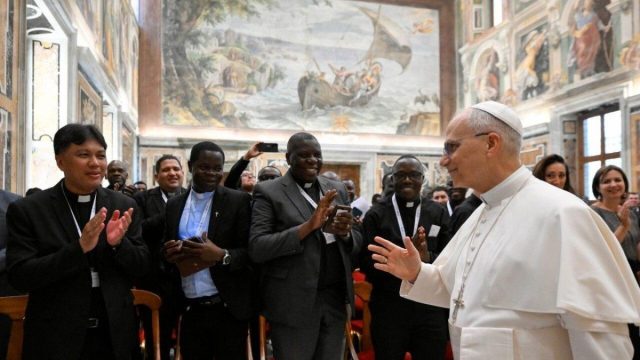
Archbishop Nwachukwu honors missionaries who gave their lives to evangelize
Speaking to 147 newly appointed bishops in Rome, the secretary of the Dicastery for Evangelization paid tribute to Western missionaries and set out a new model for evangelization in mission territories, which the dicastery calls the Church of the Sheaves

The annual formation course for new bishops, known informally as the "mini master's," is under way in Rome. It has brought together 147 recently appointed bishops and is organized jointly by the Dicastery for Bishops and the Dicastery for Evangelization. Yesterday the bishops attended several talks on priestly formation in the Aula Magna of the Pontifical Urbaniana University.
Archbishop Fortunatus Nwachukwu, secretary of the Dicastery for Evangelization, gave a talk titled "At the Service of Priestly Formation in a Synodal Church: The Church of the Sheaves." He passed on greetings to the bishops on behalf of Cardinal Luis Antonio Tagle, pro-prefect of the dicastery, who is in the Philippines following the recent death of his father.
The paradigm of "the Church of the Sheaves"
Nwachukwu's talk centered on a new missionary paradigm the dicastery is developing for apostolic work in mission territories. Local clergy and religious, he said, have gradually taken over "the reins of evangelization from the hands of Western missionaries" and "more recently are beginning to contribute to the universal Church in a spirit of synodality. That is why we are drawing up a framework for evangelization in the synodal Church which we call 'The Church of the Sheaves.'"
He described it as "an ecclesiological paradigm inspired by the words of Psalm 126," one of the Psalms of Ascent sung by pilgrims on their way to Jerusalem: "They go out weeping, bearing the seed for sowing; they come home with shouts of joy, bringing their sheaves."
Tribute to the missionaries
"In the image of the one who departs in tears, we see the missionaries who brought the Gospel to our lands. They left behind their comfort zones and their familiar surroundings, the warmth of their families, companions, friends and loved ones, to venture into unknown mission territories," Nwachukwu said. Since most of them "did not expect to return home," he said, "in a certain sense, their departure was like dying. In fact, many of them died only a few months after arriving in the mission territories. They sacrificed everything, including their lives."
Still, "they did not set out empty-handed; rather, they carried with them the seeds of the Gospel to sow in the new mission territories." Turning to the second half of the verse, Nwachukwu said: "The good news is that their efforts and sacrifices have not been in vain. The seeds they sowed have produced plants that are now flowering and bearing abundant fruit: the sheaves. We are now in the time of the harvest, of bringing the sheaves home."
Gratitude and current tensions
Speaking both as an official of the dicastery and as "part of those very fruits of the harvest," Nwachukwu thanked the Churches that sent missionaries, "heroes of our faith" who "sacrificed the best moments of their youth, and even their own lives," for the sake of values "on which the Europe we know today was built."
He closed with a remark on current tensions within the Church: "Unfortunately, sometimes, when people in our local Churches today insist on remaining faithful to those teachings of the missionaries, they are labeled conservatives. Many in the West want them to abandon the teachings received from the Western missionaries to embrace new and untested values, taught by people who do not compare, and cannot compare, with the missionaries in conviction and fraternal solidarity. We cannot abandon our heritage or neglect the past, because the future has its roots in it. Please help us to honor the memory of your heroic brothers and sisters, the missionaries, by giving a warm welcome to the fruits of their sacrifices, within the Church of the Sheaves."