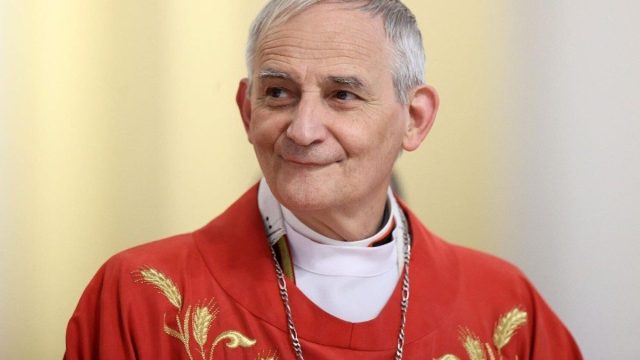
Archbishop Nwachukwu tells new bishops local customs cannot reshape the Gospel
Archbishop Fortunatus Nwachukwu, secretary of the Dicastery for Evangelization, told newly ordained bishops in Rome that cultures must let themselves be purified and transformed by the Gospel, and warned against tribalism in Church appointments

According to a September 3, 2026 report by tribunechretienne.com, Archbishop Fortunatus Nwachukwu, secretary of the Dicastery for Evangelization, spoke to new bishops in Rome about the inculturation of the Gospel and its limits. Speaking during the formation courses for recently ordained bishops, Nwachukwu said cultures must accept being "purified, transformed and opened by the Gospel" if inculturation is to avoid both syncretism and cultural fundamentalism.
The Nigerian archbishop spoke about tribalism, the caste system, racism and regionalism within Church structures. Those issues raise a broader theological question: how far can inculturation go without compromising the integrity of the Christian message? Nwachukwu said inculturation means rooting the Gospel in a particular culture and letting that culture express the faith through its own language, sensibilities and traditions. But he said this cultural diversity has one non-negotiable limit: a local custom does not become Christian simply because it is old or because it belongs to a people's deepest sense of itself.
Purification, transformation and openness to the Gospel
Inculturation reaches maturity, Nwachukwu said, when a culture allows itself to be "purified, transformed and opened by the Gospel." Christianity can take form in many cultures, he said, but the word of Christ must never be put on the same level as human customs, however worthy those customs are. Traditions should be honored for what is true and beautiful in them, but they also have to be illuminated by the light of the Gospel, corrected where necessary, and abandoned if they contradict the Gospel or the dignity of the human person.
Inculturation has clear limits, he said, and its strength lies precisely in the fact that the Gospel cannot be cut down to the size of any one culture. "Customs, however respectable they may be, are necessarily limited, while the word of Christ opens the human being to a truth and communion that transcend the divisions of birth, tribe, language or region," he said. To inculturate the Gospel is not to shut it inside the categories of one people, he said, but to let that people start from its own culture and discover the breadth of a message that transforms it.
Tribalism, belonging and communion in the Church
Nwachukwu also addressed tribalism in the Church, saying that attachment to a local community or a region is not wrong in itself. It becomes an obstacle, he said, when that particular belonging is placed ahead of universal Christian communion. "A culture evangelized by Christ becomes capable of giving and receiving," he said, adding that a community that has truly been evangelized "does not need to build walls to maintain its identity."
That approach avoids two extremes: the removal of particular cultures in the name of a disembodied Catholic uniformity, and the sacralizing of local particularities that are placed beyond the judgment of the Gospel. A particular Church always has its own history, language and culture, he said, but it must never become a "cultural fiefdom" in which Church authority is distributed along ethnic or tribal lines.
Baptism and belonging to Christ over ethnic identity
A Christian's identity comes not from geographical origin, mother tongue or ethnicity but from baptism and from belonging to Christ, Nwachukwu said. The point bears directly on how responsibilities and leadership roles are assigned in the Church. Nwachukwu warned explicitly against the "son of the soil syndrome," the practice of systematically favoring people native to a particular territory for leadership roles. "The decisive question should not be: 'Where does he come from?' but: 'Who is he?'" he said.
That standard reflects St. Paul, for whom baptism dissolves traditional dividing lines: "neither Jew nor Greek, neither slave nor free, neither male nor female; for you are all one in Christ Jesus."
Pentecost as a model of plurality without confusion
Nwachukwu pointed to Pentecost as the key to understanding the relationship between unity and diversity in the Church. At Pentecost, he said, languages do not disappear into uniformity and peoples do not stop being culturally distinct, yet all receive the same Gospel and are moved by the same Holy Spirit. "We are not called to create uniformity. We are called to prevent plurality from becoming Babel," he said, invoking the Pauline distinction between a multiplicity of charisms and confusion without coherence.