Spanish bishops to fold Pope Leo XIV's visit into 2026-2030 pastoral plan
The standing committee of the Spanish Bishops' Conference met in Madrid on September 29 and 30. It agreed to update its pastoral priorities with the pope's words from his June trip, approved aid for earthquake-hit churches and named a new information office director
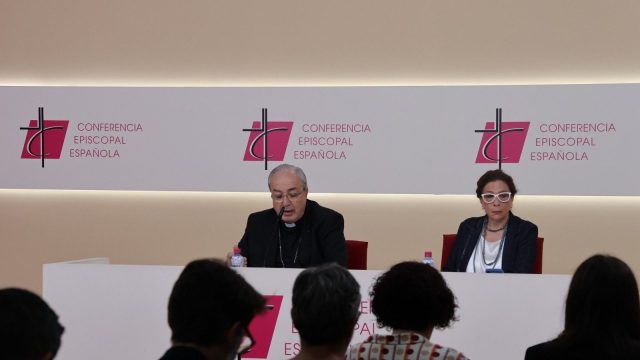
The standing committee of the Spanish Bishops' Conference held its 274th meeting on September 29 and 30 at the conference headquarters in Madrid. The secretary general, Bishop Francisco César García Magán, briefed reporters on the two days of work, which covered pastoral, synodal and financial matters as well as appointments.
Updated action plans after the papal visit
One of the main items was an update to the action plans of the conference's commissions, subcommissions and offices. The update is meant to take in the implications for each area of the speeches and homilies Pope Leo XIV gave during his visit to Spain from June 6 to 12.
The president of the conference, Archbishop Luis Argüello, told the plenary assembly in April that the text of the conference's pastoral priorities for 2026-2030, titled "¡Poneos en camino!" ("Set out on the journey!"), was open to incorporating the pope's words and the guidance he left during the trip. The updates will be presented at the plenary assembly in November.
The conference's publishing service is working on new editorial projects linked to the visit, among them "materials for reading, talking and walking together after the pope's visit." A conference working group drew up these texts, which were presented to the standing committee.
Review of the synodal process
Bishop Francisco Conesa, the conference's lead bishop for the synod, presented proposals for a review of how the conference works synodally. Bishops on the standing committee will add their own contributions, and the discussion will continue at the plenary assembly.
Conesa also reported on the diocesan assemblies evaluating the implementation phase of the synod, which are being held "following the guidance made public by the General Secretariat of the Synod last July." That work will come together in the conference's synodal assembly, planned for the second half of 2027. Preparations for the gathering will move forward at the November plenary.
Commission projects: evangelization, education, liturgy
The Episcopal Commission for Evangelization, Catechesis and the Catechumenate, chaired by Bishop José Rico, has made progress on creating an instituted lay ministry at the service of charity. It presented the standing committee with a document drawn up together with the Episcopal Commission for Liturgy and the Episcopal Commission for Social Ministry. The standing committee approved it, and it goes to the next plenary.
The Episcopal Commission for Education and Culture, chaired by Bishop Alfonso Carrasco, presented a report on the educational projects it funded last academic year, along with its proposed grants for 2026-2027, which were approved.
The Episcopal Subcommission for the Family and the Defense of Life and the Episcopal Commission for Social Communications jointly presented an assessment of Marriage Week 2026 and outlined next year's plans.
The president of the Episcopal Commission for Liturgy, Bishop José Leonardo Lemos, presented the revision of the Spanish translation of the Roman Missal. The secretariat carried out a full review and improved some texts. With the standing committee's approval, the revision goes to the next plenary.
Financial support: Spain, Colombia and a charitable project
The standing committee approved financial aid toward repairing churches in Granada damaged by the earthquakes last August. Another earthquake that same month left the diocesan seminary in Pereira, Colombia, completely unusable, and the bishops approved financial support for its reconstruction. The executive committee will set the amount.
A third allocation was approved for the Kairós project, run by the Fundación Pía J2R, which has the encouragement and backing of Pope Leo XIV and of the Spanish Bishops' Conference.
Third refresher course for bishops in San Sebastián
The third refresher course for bishops will take place in San Sebastián from July 4 to 7. Participants rated the first two editions highly, and the standing committee approved keeping the course in the same format, which "combines formation, prayer and community life." New content will be added gradually to address current pastoral and cultural challenges.
Plenary assembly agenda confirmed
The bishops approved the agenda for the 130th plenary assembly, to be held November 16 to 20. It includes follow-up items, financial matters and the usual section on appointments. Among the subjects on the table are the action plans updated with guidance from the papal visit, progress in the synodal process, and documents from the episcopal commissions.
Appointments
On the secretary general's proposal, the bishops approved the appointment of María Carmen Ramírez Moreno, a laywoman of the Archdiocese of Madrid, as the new director of the conference's information office, where she has been deputy director since 2023. She succeeds José Gabriel Vera Beorlegui, a priest of the Archdiocese of Pamplona and Tudela, who has held the post since January 2015.
They also approved the appointment of Javier María Prades López to the editorial board of the Biblioteca de Autores Cristianos (BAC), a publisher of classic authors of Christian thought.
The Episcopal Commission for Social Ministry and Human Development was authorized to appoint Juan Manuel Bajo Llauradó, a priest of the Diocese of Tortosa, as director of its health care ministry department. The bishops also cleared the Episcopal Subcommission for the Family and the Defense of Life to appoint Juan Iniesta Sáez, a priest of the Diocese of Albacete, as a permanent collaborator.
Other appointments approved were: Francisco José Cortés Martínez, a layman of Córdoba, reelected president of the Association of Church Librarians; Rosa María Murillo Fuentes, a laywoman of Plasencia, reelected president of the Cursillos de Cristiandad movement; Javier Ramos Guardiola, a layman of Cartagena, as president of Acción Católica General; David Míguez Gallego, a layman of Santiago de Compostela, as delegate of the Federación Scouts de Galicia (Scout Federation of Galicia); Julia Bonilla García, a laywoman of Coria-Cáceres, as president of the Catholic Scouts of Extremadura; and Raúl Hernández Pérez, a priest of Coria-Cáceres, as regional chaplain of the same scouting group.