Madrid's Cardinal Cobo says no party can claim to be 'the Christian vote'
Speaking to a national meeting of lay leaders in Spain five weeks before elections, Cardinal José Cobo warned against the "culture war" and against bending faith to fit a political ideology
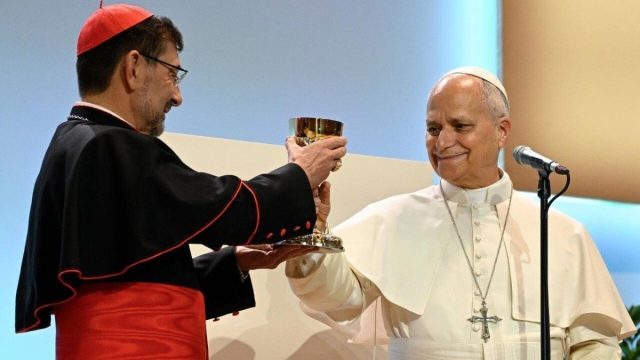
Cardinal José Cobo, archbishop of Madrid and vice president of the Spanish Bishops' Conference, Spain's counterpart of the USCCB, said on Saturday, January 24, that "no party can claim to say: 'We are the Christian vote.'" He was speaking at the 47th National Conference of Lay Apostolate Delegates.
The conversation was led by Cristina Sánchez Aguilar, editor of Alfa y Omega, the Madrid archdiocesan weekly. More than 120 people attended in person and more than 1,250 signed up to follow it online, under the theme "Iglesia que camina con la humanidad" ("A Church that walks with humanity").
Cobo encouraged believers to talk about voting with other Christians, including those who back different parties, and to make the decision by weighing the complexity of society as a whole rather than their own interest or that of their group. In a polarized society, he said, it is a "prophetic provocation" when people with opposing political convictions can look each other in the eye and talk with respect. The commitment does not end at the ballot box, he said: voting also means continuing to assess the decisions of elected representatives.
Risks for Christian public life
Cobo identified two dangers: closed circles where only like-minded voices circulate, and the so-called "culture war," which turns society into an adversary and ties the faith to particular political positions. He also warned against repeating formulas from the past and against adapting so far that Christian identity is diluted. The underlying obstacle, in his view, is subordinating faith to ideology: picking out of the Gospel only what confirms one's own convictions.
Against that, he called for a formation of conscience grounded in prayer, in knowledge of Jesus Christ and in the humility to accept correction. That process requires community, deliberation and responsibility for the consequences of the decisions taken. Listing the values a democracy needs, Cobo named human dignity, respect for life, welcome for migrants, the family, work, the separation of powers and institutional checks.
A method for changing society
The starting point for his whole talk was a question a young man put to a Christian group: "Are your groups transforming society?" For the cardinal, that is "the big question" the Church's social doctrine has to answer. As a method he proposed an updated version of see-judge-act: understand what is happening, ask why it is happening, and discern what can be done together. That means starting always from the Gospel and from the most vulnerable, with human dignity as the reference point, and reviewing the results afterward.
Cobo questioned measuring Christian commitment by the hours spent on parish activities. "Family life, professional life, civic life are places of vocation," he said, so raising children, taking part in family associations or taking on responsibilities in the neighborhood are also part of the lay mission. He described synodality as an "antivirus to individualism" and said he regretted that some inside the Church reduce Caritas to just another NGO.
Work, technology and housing
On work, Cobo asked whether a job is treated as a disposable commodity or as an expression of the dignity of the person. He called for workers to be given a voice and for scrutiny of how the gains from technology are distributed. He questioned whether company profit should be the final criterion and whether its returns belong only to those who put up the capital: "Workers are contributing their lives," he said.
On artificial intelligence, he recalled that the document Magnifica humanitas makes the protection of each person the guiding criterion. He asked who controls the technology, what it is used for and who benefits from it, and called for transparency and attention to those who suffer its effects. Against a culture focused on success and results, he defended the value of limits, fragility and care.
On housing, Cobo referred to the protests in the Puerta del Sol, the central square in Madrid, and asked: "Has anyone listened to them?" He said there is "a cry, regardless of where it comes from" and that it has to be addressed: "They must be listened to, not labeled." Having a home in which to build a life and a family plan is, in his view, a requirement of human dignity. He introduced the idea of "political charity": helping one specific person also commits you to acting on the structural conditions that keep others in the same situation.
The Church as a bridge
The Church, he said, is called to "set the table": to make encounters possible, including between leaders of different parties, and to build networks that allow people to listen to one another. Against those who profit from polarization, he pointed to communities able to rebuild bonds with a word that is "disarmed and disarming." He called for a Christian presence in culture, politics, the economy and the professions, respecting the autonomy of those fields, and asked that those who take on political responsibilities be cared for and supported.
The meeting was part of the formation program on "Public Presence" that grew out of the 2020 Congress of the Laity. It worked on four areas: the common good as the horizon of political action; drawing up proposals to tackle poverty; involvement in the local area and neighborhood associations; and encouraging ecological commitment in Christian communities. The program also included a cultural session on sacred art, the Sunday talk "Aquí y ahora: Sinodalidad y compromiso en la vida pública" ("Here and now: Synodality and commitment in public life"), and a presentation on the process for members of the Lay Advisory Council. Raúl Tinajero Ramírez, director of the Commission for Laity, Family and Life, closed the event.