Church education council honors Luis de la Fuente in first Stella Awards
The General Council of the Church in Education presented a new website and a doctrinal booklet on September 30 and announced the winners of its first Stella Awards, to be presented in Salamanca on October 28
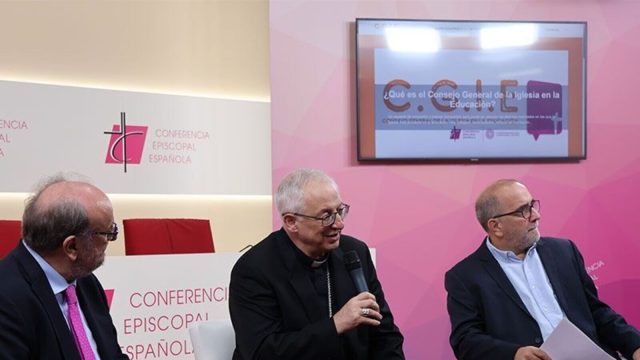
The General Council of the Church in Education (CGIE), which brings together the Church's educational institutions in Spain, presented three initiatives on September 30: the CGIE's new website, Cuaderno 0, a booklet titled "Iglesia y educación" (Church and Education), and the 2026 Stella Awards with their winners. The council said they amount to "a boost to the development of this space for encounter and collaboration" among the Church's educational bodies.
Speaking at the event were Bishop Alfonso Carrasco Rouco of Lugo, president of the Episcopal Commission for Education and Culture; Carlos Esteban Garcés, secretary general of the CGIE; and Antonio Roura Javier, director of the secretariat.
New website: making the educational constellation visible
The CGIE describes its new website as "a space for encounter, knowledge and participation." Its purpose goes beyond institutional activity: it "seeks to help people discover the breadth and diversity of the Church's educational presence."
The site sets out the council's identity, its structure and its nine areas of work, together with its main projects. Each area will gradually get its own section describing its work, its members, its initiatives and the challenges it faces. The website also aims to "encourage relationships between the areas," starting from the recognition that although the educational mission takes very different forms, all of them "share questions and possibilities for collaboration."
Content is organized in three editorial strands: "Actualidad CGIE," on institutional activity and calls for applications; "Horizonte educativo," with analysis of trends and emerging challenges; and "La Iglesia en la educación," which focuses on initiatives, experiences and institutions. The council calls it an open and gradual project that aims to become a "point of reference for institutions, professionals, families, media and anyone interested" in the Church's contribution to education.
Cuaderno 0: a joint reflection on the educational mission
The CGIE's Cuaderno 0 is titled "Iglesia y educación. Una constelación educativa al servicio de la persona y del bien común" (Church and Education: An Educational Constellation at the Service of the Person and the Common Good). It was published as part of the council's aim of "encouraging knowledge, understanding and updating of the Church's magisterium on education."
What sets the booklet apart is how it was put together. It did not come out of a single author's reflection but from the joint work of CGIE members representing different responsibilities, institutions and educational experiences. That process made it possible to "gather different perspectives on the Church's presence" and to identify the links between them, reflecting what the council itself is: "a space in which plurality helps build a shared vision."
The booklet sets out the main lines of the Global Compact on Education promoted by Pope Francis and relates them to the priorities identified by Pope Leo XIV in his apostolic letter "Diseñar nuevos mapas de esperanza" (Designing New Maps of Hope).
From the Global Compact to new maps of hope
The Global Compact on Education called for a broad alliance to put the person at the center, listen to children and young people, promote the dignity of women and recognize the family as the first educator. It also called for opening up to welcome and inclusion, renewing the economy and politics, and caring for our common home.
Leo XIV takes up that horizon and relaunches it in new circumstances. His contribution adds three priorities: "care for the interior life"; "a human understanding of technology and artificial intelligence that places the person before the algorithm"; and "an education for a disarmed and disarming peace, capable of building bridges."
The booklet brings the two bodies of teaching into dialogue and connects them to the reality of institutions, educators and communities. It does so not as a closed program but as an "invitation to ask what they mean today for each educational area" and how they can be translated into specific decisions.
The materials are arranged in four movements: a direct reading of the magisterial text, an understanding of its core ideas, a comparison with educational reality, and discernment of the personal, community and institutional consequences. The booklet and its materials are available on the CGIE website, and the printed edition can be bought through EDICE.
Stella Awards: stars that light paths of hope
The Stella Awards were created to "recognize people, institutions and projects that embody the Church's educational mission in a particularly significant way." They do not seek to rank initiatives or offer an exhaustive picture, but to "discover and share experiences capable of inspiring others."
The name refers to the star as a sign of direction and is tied to Leo XIV's letter, in which he presents Catholic education as an "educational constellation: a living and plural network of schools, universities, vocational training centers, movements, social and cultural initiatives, families, communities and projects." As the pope puts it: "each star has its own brightness, but together they trace a route."
The nine categories correspond to the CGIE's nine areas of work. This first edition also includes a Special Award for an educational, ecclesial and cultural contribution.
2026 winners in nine categories
Schools with a Christian ethos: Colegio Nuestra Señora de los Infantes in Toledo, for its long history as an institution of the Church, its historic link to Toledo's cathedral and the continuity of an educational project of Christian identity. The council said that makes it probably the oldest school in Spain.
Universities: the Chair of Innovation and Digital Mental Health at Comillas Pontifical University, for a multidisciplinary contribution combining research, training and knowledge transfer to respond to the challenges of mental health and digital transformation, placing the person above technology.
Special education: the Congregation of the Sisters of Our Lady of Compassion, for more than two centuries of support for vulnerable people and for its pioneering presence in Spain in the education of children and young people with disabilities, particularly through Colegio María Corredentora in Madrid. The school serves 328 students.
Religion teachers: the project "El teatro vive en mi cole" (Theater Lives in My School) by Patricia Marmol, a religion teacher at the CPEE Vicente Ferrer public special education school. It started in the religion classroom and uses theater as a teaching space for inclusion, creativity and participation by students with special needs, making their abilities visible.
Christian teachers: Francesc Torralba Roselló, of Barcelona, for a Christian teaching vocation carried out with academic rigor. His career as a philosopher, theologian, educator and professor has helped build bridges between faith, education, culture and society.
Vocational training: the Salesian Congregation, for its sustained work in basic-level vocational training, offering skills, support and opportunities to young people who have run into difficulties, from the charism of Don Bosco.
Non-formal education, leisure and sport: Luis de la Fuente Castillo, for his educational leadership and his record of supporting young generations through sport, valuing effort, responsibility and personal and collective growth.
Parish, family and school: Francisco Javier Velasco (Fano), of Málaga, for a career that brings together an educational vocation, family and community life, a presence in public schools and artistic work. His illustrations have created a simple and profound language used by teachers, catechists and families.
Communication and cultural projects: the Escolanía de Lluc choir school in Mallorca, for more than seven centuries of academic, musical, artistic, spiritual and Christian humanistic formation, keeping alive an educational, cultural and liturgical heritage of wide reach.
Special Award: 500th anniversary of the School of Salamanca
The CGIE's 2026 Special Award goes jointly to the University of Salamanca, the Pontifical University of Salamanca and the Pontifical Faculty of Theology San Esteban. The council described them as the present-day heirs of a university and ecclesial commitment of universal reach, decisive in promoting human dignity and building social coexistence. It said their 500th anniversary in 2026 deserves recognition for having lit the path of dignity and human rights.
Ceremony: October 28 in Salamanca
The September 30 presentation announced the winners and the reason for each award. The prizes will be handed out on Wednesday, October 28, 2026, at 7 p.m. in the Aula Magna of the Pontifical University of Salamanca, during the CGIE plenary.