Spanish priest says he will stay in Benin parish despite jihadist threat
Rafael Quirós, a diocesan priest from Barbastro in Spain, has led a parish in Mari Besen Gbere since 2020, a rural area of Benin where only 2 percent of the population is Catholic and the risk of jihadist attack is high
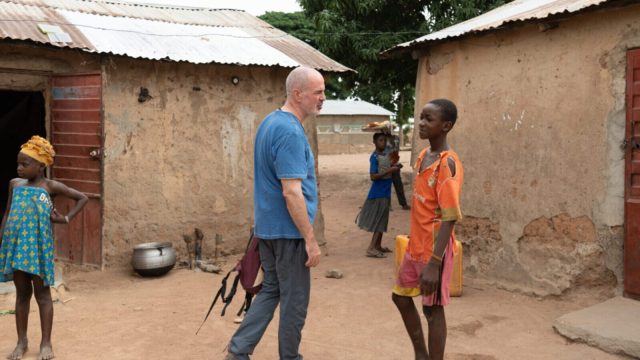
Rafael Quirós, a diocesan priest from Barbastro in northeastern Spain, says of his work in Benin: "I'm not looking to be a martyr, but you have to accept the risk." Parts of the West African country are at high risk of jihadist attack. Since 2020 he has led the parish of Our Lady of the Pillar in Mari Besen Gbere, a rural area where only 2 percent of the population is Catholic. From 2011 to 2020 he served in the remote parish of Fô Bouré, in the diocese of N'Dali, where he worked in subsistence farming and built ties with local ethnic groups including the Bariba, Fulani and Gando.
From IT worker to missionary
Quirós worked in information technology before he was ordained. He said he had "a girlfriend, I was working, everything was going very well for me." But at one point, "I realized that something was missing in my life, that I needed something more." That restlessness led him to the priesthood, though he admits he was angry with God: "I got a bit angry with God because I said leave me alone, I'm 30, I'm fine, everything is going well for me, I'm a good guy. I go to Mass on Sundays, I treat people well."
The area where he works is very poor, with a subsistence economy. He described the local housing: "Picture huts, but now it isn't so pretty or so romantic, because they are no longer huts with thatched roofs. Now they put up corrugated metal sheets, which is a mistake because they get incredibly hot." Despite the hardship, "what you find is joy. These are people who want to smile, who want to have a good time."
The role of local catechists
Quirós works with the support of catechists and committed local Catholics, whom he considers the real protagonists. "They are the protagonists of the Church," he said. "At the end of the day, I'm a foreigner and I speak their language pretty poorly. I try; I celebrate Mass only in their languages. I don't even celebrate it in French."
There are between 30 and 40 villages in the territory, but so far he reaches only 10. The farthest is 28 kilometers (17 miles) away over what he called "hellish tracks." His aim, he said, is "to speak about Jesus Christ, to bring the good news, to announce that God has given his life for you and that it is worth it, and that it is something that can give anyone back their dignity."
He added that "we missionaries make the best social choice there can be, which is to give people back their dignity so that they can fight, so that there is education, so that there is health care, so that there are social rights, to speak about Jesus Christ." It is not a question of results, he said, because "God does things his own way, and my part is to sow and let God reap."
Living under jihadist threat
The parish is in an area at high risk from jihadism. It is home to displaced people who fled the north looking for land to farm. There is tension and fear, because the killers "turn up one day shooting, on motorbikes, and they kill, they kidnap, they rape, they do every atrocity they want." Quirós said he is not afraid, perhaps "because nothing has happened in my parish yet, or because I'm a bit brainless, that comes into it too, or because I trust God."
He said he stays because "those people need us to be there." His conviction is reinforced by the testimony of a Nigerian priest from the neighboring parish, who told him: "we are ordained knowing that we could very easily be martyred. We celebrate every Mass as if it were the last Mass, because we don't know whether they will kill us on the way home."
For Quirós, this is a basic truth: "The Church has spread through the world thanks to the martyrs." He is also clear that "I am not the message, I am the messenger. The message is what matters."