Bishop Erik Varden of Norway says pornography makes lasting love harder
Erik Varden, bishop of Trondheim, said early exposure to pornography creates a formidable obstacle to real love. He published his reflections after a meeting of bishops' conference presidents in Rome marking 10 years of Amoris Laetitia
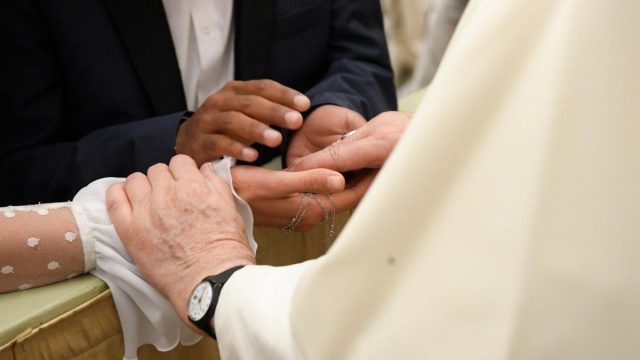
Erik Varden, bishop of Trondheim, Norway, has called marital fidelity one of the most powerful witnesses Christian families can give to a society that fears permanent commitment. He published his reflections on October 15, after taking part in a meeting of presidents of bishops' conferences held in Rome for the 10th anniversary of the apostolic exhortation Amoris Laetitia.
Varden said his comments were personal and did not represent the official conclusions of the assembly, whose report had not yet been published. He wrote about the difficulties families face, the preparation of young people for marriage and pastoral accompaniment in difficult situations.
Loss of a shared sense of what it means to be human
The difficulties families face are not only economic, cultural or sociological, Varden said. There is a deeper problem, he said, in the loss of any shared understanding of what it means to be human. "Except within interest groups, it is hard to find shared words to describe what a woman is, a man, a child," he wrote.
Varden said he particularly regretted that relationships are increasingly treated as practical transactions that end once the benefit disappears. "People stay together as long as they get some benefit or satisfaction, then they move on," he said. In that setting, he said, a lifelong commitment can come to look absurd, something he tied directly to the loss of any sense that one's own existence is a gift.
Varden said he also sees a hopeful trend among young people and adults who are tired of passing relationships. His pastoral experience, he said, is that many people of different ages are looking for a truth on which to build their lives and are rejecting what is fleeting.
Pornography and the inability to love what is real
The bishop turned specifically to the influence of pornography on young people's emotional formation. Early exposure to a world in which sexuality is presented as something to consume, where the object of desire is endlessly interchangeable but always physically perfect, and where romance is absent, creates a formidable obstacle to real love, he said.
"When one has been harassed from childhood by a universe of lust in which sex is a matter of consumption, in which the object of desire is constantly interchangeable but always physically perfect, from which romance is absent, it is a massive step, perhaps an insuperable one, to enter a lasting and faithful relationship with a concrete human being who is fallible and in need," he said.
Varden said he has also had an encouraging pastoral experience. Since his book Chastity was published three years ago, he said, he has met many young people in different countries who want to understand what chastity means. "They are looking for friendship and a stable love," he said, adding that this is not necessarily a majority trend but a growing current that deserves attention.
To support those young people, he called for a language of truth that names things calmly, without violence or despair, and said they need help to be reconciled with their own identity and their bodies. "If we want to prepare young people for marriage, we must first help them find peace with themselves," he said.
Radical transparency before making promises
Turning to the first years of marriage, Varden described a couple who, before their wedding, spent a weekend in a cabin telling each other their life stories in full, including mistakes, failures and successes. The aim was to make sure that no unacknowledged obstacle from the past could surface later in their life together.
He presented that as an example of honesty that can head off later conflict and strengthen the foundation of a marriage. "The essence of love is to know that I can be who I am, without masks, and still be loved," he said. That shared vulnerability, he said, is what marks genuine love, the love God himself practices.
Varden noted that the marriage rite asks, "Have you come here freely?" The freedom on which sacramental validity rests requires that the spouses really know whom they are marrying, he said. Radical transparency before the wedding, he said, is an essential investment in the future strength of the union.
Accepting the suffering that comes with love
Marriage means accepting the suffering that can come with married love and parenthood, Varden said, without that erasing the beauty of the vocation. "Any conjugal and parental love involves suffering. It will pierce the heart. It will require that life be poured out so that others may live," he said.
Marriage also calls for a gradual change of language and mentality, he said: learning to replace "I want" with "we want," and "I have" with "we have." That move into the first person plural, he said, is what really marks the beginning of a married life.
Married couples need a community to hold them up, above all when difficulties arise, Varden said. He said parishes have a specific responsibility: to offer practical help, closeness, a sense of humor and compassionate advice. "Couples should not see themselves as self-sufficient, expecting to generate all their own resources and contentment," he said.
Marriage as a school of conversion
On complex family situations, the bishop warned against an idealized picture of marriage that ignores its real difficulties. He compared married life with monastic life: both require facing trials with realism, patience and a willingness to change.
Problems can become occasions to overcome selfishness and purify love, Varden said, as long as people can look beyond the immediate suffering and place it in the wider perspective of their own conversion. "When things are difficult, we contract our perspective. We see only our present pain, not the road that may stretch beyond," he said.
Early monastic literature, such as the Sayings of the Desert Fathers, offers a realistic, experience-based teaching that could be adapted for families, he said. He suggested compiling a collection of sayings for family life, "showing how trials can be handled constructively in the light of Christ's commandments and his effective grace."
Welcoming people in irregular situations without relativism
Varden also addressed Catholics in relationships the Church considers irregular. He called for communities able to recognize those circumstances without relativizing them, while welcoming the people involved with Christian friendship and letting them take part in the life of the community.
He praised the example of the faithful who come forward Sunday after Sunday for a blessing at Communion, knowing they cannot receive the sacrament, and entrusting themselves to the mercy of God at work in the Church. "Their example of fidelity builds up the Christian community greatly. It bears witness to the living realism of the sacrament and to the virtue of hope," he said.
Fidelity as the family's first mission
In the last part of his reflection, Varden said the main mission of the Christian family is to bear witness to a stable love. "A family is missionary, therefore, principally by its fidelity," he said.
The marriage promise to stay together until death makes the fidelity of God's love visible in history, he said. At a time when many traditional structures of social cohesion are coming apart, he said, that mission matters all the more: "By promising to remain faithful to one another until death, husband and wife instantiate in history the reality of God's love."
Alongside fidelity, he pointed to hospitality as another essential part of the family's mission. Varden encouraged Christian homes to open themselves to others and to keep ties with the Church community, not as closed spaces but as places where new life is generated and the faith is handed on.
He also said specific measures are needed to make it easier for young couples to have children: affordable housing, child care and accessible education. "This is not only a pastoral question, but also a political one," he said.
Small daily acts as the foundation of fidelity
Varden closed by stressing the importance of small daily acts of fidelity, which constantly renew the decision to love made in marriage. "It is not a matter of being continually ecstatic with happiness," he said, but of honoring commitments through small, consistent actions that make it possible to face difficulties with Christian hope.
Faithful families, he concluded, are not a relic of the past but a prophetic sign of the Gospel for the present.