Cardinal Parolin urges students at Italian Parliament to help build peace
The Vatican secretary of state told university students in Rome on October 15 that security comes from good relations between nations, not from making enemies or weapons, and called on them to carry the Church's social teaching into public life
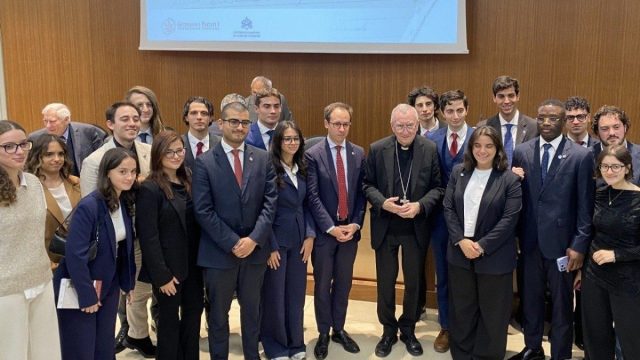
Cardinal Pietro Parolin, the Vatican secretary of state, told a group of university students gathered at the Italian Parliament on October 15 that younger generations bear a responsibility for building a peaceful future. He spoke at the closing of an international conference on John Paul I, organized by the Vatican John Paul I Foundation with the Pontifical Gregorian University and the Pontifical Committee for Historical Sciences.
"Development is a path toward peace," Parolin said, restating the Holy See's commitment to a peace built on good relations between peoples and on international cooperation. He addressed the crisis of trust between nations, the regulation of artificial intelligence and the arms race. "Security is created only by maintaining good relations with everyone, and not by creating enemies or manufacturing weapons," he said. He added: "If you want peace, you have to build peace, not war."
Impunity as an obstacle to multilateralism
Parolin's analysis of the crisis of trust in the international community focused largely on impunity. "Atrocities can be committed without anyone answering for them," he warned. He linked the effectiveness of international organizations to the ability of states to recognize their authority and work with them.
"The problem of multilateralism is a problem of trust. If trust is lacking, it is impossible to collaborate," Parolin said.
The Middle East and the two-state solution
On the Middle East, Parolin repeated the Holy See's support for a two-state solution. He said other alternatives could be considered, but that this is currently the only workable option capable of guaranteeing the right to self-determination. He noted that the Holy See has backed that solution since 2015, when the Comprehensive Agreement recognizing the State of Palestine was signed. He cited United Nations Resolution 181 of 1947, which provided for the creation of two states and a special international regime for Jerusalem.
Artificial intelligence and the technology gap
On artificial intelligence, Parolin pointed to three main concerns: its effects on employment, its use in weapons and the technology gap between countries. He called for international talks to regulate its use, particularly in the military field. "The solution is very clear: sincere collaboration between nations," he said.
Interreligious dialogue against violence in God's name
Interreligious dialogue featured prominently in Parolin's remarks. He called on religious leaders to stand together against those who use faith to justify violence. "The name of God cannot be a justification for promoting violence," he said, recalling the importance of the prayer for peace convened by John Paul II in Assisi.
Training young people in social doctrine
Parolin devoted part of his remarks to the political formation of young people. He encouraged them to take responsibility for carrying the principles of the Church's social doctrine into public life. "They must feel a special responsibility and duty: to form themselves to be protagonists in promoting the principles of the social doctrine of the Church," he said.
Weapons and the redistribution of resources
Turning to the arms race, Parolin recalled that since the time of Paul VI the Holy See has argued that part of the money spent on weapons should go to the development of peoples.
He closed with a summary of his argument: "We must be convinced that we are all in the same boat. The solutions to conflicts are for the benefit of everyone." Peace and security are not competing goals, he said, but are built together through good relations and cooperation.
The conference marked the legacy of John Paul I and his 1978 Urbi et Orbi message on "protecting and fostering peace in this troubled world."