Cardinal Gugerotti says religion must regain its place in understanding the world
Cardinal Claudio Gugerotti, prefect of the Vatican's Dicastery for the Eastern Churches, and Italian Ambassador Giampiero Massolo discussed religion, security and global disorder at the Italian Embassy to the Holy See in Rome
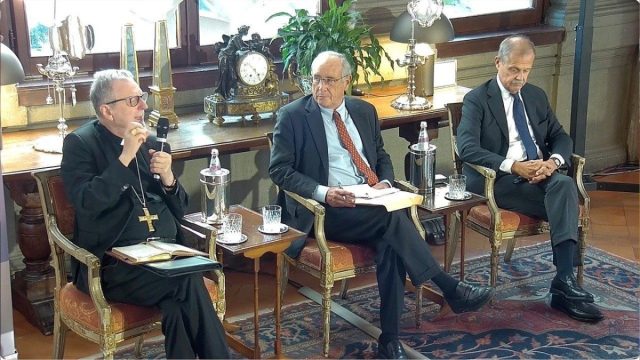
Cardinal Claudio Gugerotti, prefect of the Dicastery for the Eastern Churches, the Vatican office responsible for the Eastern Catholic Churches, took part in a debate with Ambassador Giampiero Massolo at the Italian Embassy to the Holy See. The event was part of the 17th Festival of Diplomacy in Rome, and the journalist Massimo Franco moderated. Gugerotti set out the question that ran through the discussion: anyone who wants to understand this world has to give religion back the central place that belongs to it.
Religion as a fundamental component
Gugerotti framed the problem in cultural terms. He said analysis, and even textbooks, now look back barely 30 years, so that history is ignored and with it the weight of religion. That factor, he said, "remains a fundamental component of global identity."
He pointed to the tensions in the Holy Land, where the three great monotheistic religions coexist with great difficulty. He also cited the countries of the former Soviet Union, where decades of state atheism failed to wipe out either the fabric of the Church or the religious life of their peoples.
Papal diplomacy: discreet and quiet gestures
From the same perspective, Gugerotti described the style of papal diplomacy: discreet, quiet gestures, away from the media spotlight. He also mentioned the telephone calls popes make to heads of state, whose main purpose, he said, is to get the message to those populations that they are not alone.
The real risk in ignoring the religious dimension, Gugerotti said, is not declared atheism but indifference toward a reality that has shaped and continues to shape the world order.
Security as the priority of states
Massolo addressed why religion takes up less and less space in contemporary politics. He pointed to the logic that governs the decisions of states: "When it comes to choosing, states tend to put the principle of security ahead of any other." He gave three specific examples: Russia's decision to invade Ukraine, Europe's effort to prevent a crushing victory for Moscow, and the "America First" slogan of US President Donald Trump. In each case, he said, security returns to the foreground and pushes aside every other consideration.
A two-tier international system
The debate turned to international disorder. Massolo described a system with two levels. At the top are the United States, China and Russia, which, despite its weaker economy compared with the other two, retains decisive weight because of its nuclear arsenal. These three powers do not seek direct confrontation but want to preserve enough strategic compatibility to keep local conflicts from escalating into a global collision. The last meeting between Trump and Chinese President Xi Jinping produced the phrase "constructive strategic stability" as the guiding concept of that approach.
At the lower levels of the system the picture is completely different. "Conflicts are multiplying, chaos reigns: wars do not end, there is fighting without reaching peace," Massolo said. At most, he said, the result is an armistice or a precarious balance.
The fragility of the European Union
The discussion also took in the European Union's growing fragility. An institution that built much of its influence on its ability to produce and project rules now faces the selective application of those same rules. Its normative strength risks turning into a weakness, and variable geometry, in which member states integrate at different speeds, appears as one of the few available ways out, though it offers no reassuring prospects.
Open questions
Several questions ran through the debate and were left open. How can religion, and the historical identity it carries, be reconciled with the security and national interest priorities that guide governments? How much room does diplomacy still have in a system where rules carry less weight? And are the available intellectual tools enough to read a world whose complexity lies not only in the geopolitical chessboard but in the effort to understand it?