Oppression of Christians worsened in 55 percent of countries studied, papal charity reports
Aid to the Church in Need's biennial report "Persecuted and Forgotten?", released in London on October 27, 2026, examines 18 countries and says conditions deteriorated in 55 percent of them and improved in none
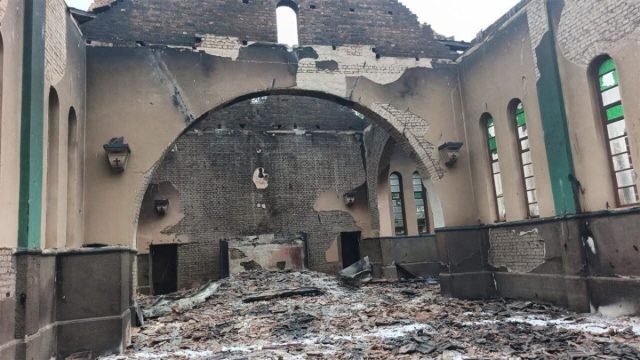
Aid to the Church in Need (ACN), a pontifical foundation, released its biennial report "Persecuted and Forgotten?" on October 27, 2026, at Portcullis House, a parliamentary building in London. The report covers the period from August 2024 to June 2026. Its 44 pages examine the situation of Christians in 18 countries in Africa, Asia, the Middle East and Latin America, and conclude that oppression has worsened in 55 percent of the territories studied, with no improvement recorded anywhere. The figures gathered put the number of Christians directly exposed to persecution worldwide at 220 million.
John Pontifex, head of press and public affairs at ACN UK, said at the launch that 20 years after the organization published its first report of this kind, the oppression of Christians remains "a human rights catastrophe that the world refuses to acknowledge." Pontifex said Christians face persecution in more countries than any other religious group. "There are as many as 165 countries where Christians suffer discrimination, oppression or persecution. That is far more than any other religious group, so we need to tell their story and take it to our friends, our family, our parish and our political representatives," he said. The most recent figures from the Pew Research Center, which the report draws on, show that anti-Christian harassment, ranging from verbal abuse to killings, was recorded in 165 countries in 2023, compared with 160 in 2021.
The report identifies three main drivers behind the deterioration: the spread of jihadism, repression by authoritarian regimes, and the growth of religious nationalisms that treat Christianity as alien or foreign. Oppression by authoritarian regimes has reached "unprecedented levels," the report says, in countries with global or regional influence where anti-Western sentiment has grown sharply.
Sub-Saharan Africa: the worst affected region
Sub-Saharan Africa is a major focus of the report. Six of the 10 countries most affected by terrorism according to the Global Terrorism Index 2026 are in Africa: Burkina Faso ranks second worldwide, Niger third, Nigeria fourth, Mali fifth, Somalia seventh and the Democratic Republic of Congo eighth. ACN identifies the Sahel as one of the main centers of Islamist violence, with jihadist groups controlling at least 40 percent of Burkina Faso, where they impose an extremist reading of Islam. In the areas they hold, women are forced to cover their faces in public and men to grow beards, Christian teaching for children can be banned, and those who refuse to comply risk expulsion or public execution. Christians are explicitly targeted, the report says, in "the campaign to impose Islamist ideology."
On August 25, 2024, in Sanaba, a town in the diocese of Nouna, 26 men were killed by fighters from JNIM, an Al Qaeda affiliate. The victims, chosen from among Christians, followers of traditional religions and people regarded as hostile to the jihadists, were taken to a Protestant church before their throats were cut. In the following days, attacks on three Catholic parishes drove about 5,000 women and children to flee. The report's analysis says the episode shows how religious violence also becomes an instrument of demographic change: by terrorizing the population, armed groups empty villages and gradually erase parish structures.
The report raises particular concern that Mali ranks fifth in the world for terrorist activity. Christians living in areas under Islamist occupation face oppression that includes the burning of churches and the imposition of religious taxes, and the persecution is severe enough to make it impossible for them to live in many jihadist-controlled areas.
In Nigeria, large-scale attacks on mainly Christian settlements in the central region known as the Middle Belt have helped produce more than 3 million internally displaced people in the country. Of the more than 3.5 million displaced in total, at least 1 million are believed to be Christian. The report says the clashes stem from several factors, including jihadist terrorism, crime, ethnic rivalries and disputes over land, and that not all the victims are Christian, although certain attacks do target communities explicitly because of their faith. Solomon Ako, a 33-year-old Christian, said he was kidnapped near Zaria. His captors demanded that he convert and, when he refused, he was beaten, whipped and chained. With other hostages, he was held for hours in cold water up to his neck.
In Mozambique, and particularly in Cabo Delgado province, ACN documents killings, kidnappings and the destruction of churches by militias linked to the Islamic State. The report says the rise of extremism has had "devastating consequences for Christian communities," whose members are seen as an obstacle to the goal of establishing an Islamic caliphate and controlling the region's mineral resources. According to the report, security and basic rights in Mozambique have deteriorated steadily, making it "one of the countries most affected by terrorism in the world." Despite military intervention by Rwanda and neighboring countries, the violence continues. The report cites around 1,000 Christians killed in Cabo Delgado since 2017, some of them beheaded.
Sudan is facing the world's largest humanitarian crisis, the report says, describing the situation as close to "genocide." The conflict underway since 2023 between the Sudanese Armed Forces (SAF) and the Rapid Support Forces (RSF) has displaced millions of people and killed more than 150,000, with some estimates putting the figure as high as 250,000. ACN has collected evidence indicating that Christians have suffered disproportionately: churches are attacked, priests tortured and the faithful pressured to renounce their faith or face hunger as part of an Islamist campaign of repression. More than 100 churches are reported to have been damaged or destroyed since the war began.
In Egypt, the report says overall figures on the scale of persecution are hard to obtain, but it documents more than 30 kidnapping cases in 2024. In Upper Egypt, families continue to report the abduction of girls, their forced conversion to Islam and forced marriage. Islamic institutions, including Al-Azhar, and the police have been accused of complicity. Communities in Upper Egypt have also suffered violent attacks, and the authorities frequently fail to hold the perpetrators to account. The report also acknowledges "positive gestures by the state toward religious communities" in the country.
In Eritrea, the report finds the situation unchanged: the government has "severely" restricted religious freedom and unlawfully detained people belonging to "unrecognized denominations," including minors. Although there were some releases in the final months of the period studied and no new arbitrary arrests were recorded, "the overall picture has remained one of intrusive and constant interference in religious life," the report says.
Asia: administrative repression and structural violence
In Asia, the methods of persecution differ but are no less serious. In China, the authorities have tightened control over unregistered Christian communities, with a wave of arrests that began in late 2025 and continued into 2026. The government requires recognized religions to operate under the supervision of organizations approved by the Communist Party. Since September 2025, new rules have sharply restricted religious activity online: broadcasting liturgies, preaching or teaching aimed at minors requires special permits, and in some provinces young people under 18 are barred from taking part in worship. Benoît de Blanpré, director of ACN in France, said that "administrative, judicial and police persecutions are increasing, contributing to the surveillance of the Chinese state, which wants to shape the churches to the ideology of the Party."
In North Korea, simply owning a Bible can lead to arrest. The report mentions roughly 190,000 people reportedly held in the country's prisons and labor camps, among whom Christians are thought to make up a significant share, though it acknowledges that no reliable count exists of those detained solely for their faith.
In Iran, arrests of Christians doubled over 12 months as repression intensified. In India, ACN counts more than 700 acts of anti-Christian violence in 2025. Religious services have been disrupted, churches vandalized and families prevented from burying their dead according to their rites, with some forced to exhume the remains of relatives. The violence comes amid the advance of Hindu nationalism and the spread of so-called anti-conversion laws. In Pakistan, the abduction of young Christian women, forced conversions to Islam and forced marriages are another form of systematic persecution.
In Myanmar, the Burma Research Institute estimates that 343 churches or other Christian buildings were attacked by the military junta's forces between the start of the conflict and the end of 2025.
Latin America: state repression and blocked access
In Nicaragua, the Ortega-Murillo regime has stepped up repression of Christians. It arrests and exiles clergy, blocks ordinations, confiscates Church institutions, is responsible for the forced disappearance of opponents, among them many Christians, and bars people carrying Bibles from entering the country.
The international call for religious freedom
Caroline Hull, national director of ACN UK, put a direct question to those attending the launch. "These people are like you and me. If someone said: 'Renounce your faith or I will take your children,' what would you do? If someone said: 'I will let you out of prison if you turn your back on Jesus Christ.' These are relevant questions we have to ask ourselves, and we need to remember that these people are like us," she said.
In October 2025, receiving an ACN delegation, Pope Leo XIV said religious freedom is "a cornerstone of any just society," because it safeguards the moral space in which conscience can be formed and exercised. "Religious freedom is not merely a legal right or a privilege granted to us by governments; it is a fundamental condition that makes reconciliation possible," the pope added.
At the launch, Pontifex called on every country and on the United Nations to fully apply Article 18 of the Universal Declaration of Human Rights, which enshrines religious freedom. "We are not asking for special treatment, simply that people come together to put an end to acts of oppression, whether that is people being kidnapped for their faith, or people being dismissed from their jobs for reasons connected to their faith... And also for those who are unjustly tried and sentenced to life imprisonment for crimes they have not committed, such as blasphemy laws, which are applied arbitrarily. And recognizing that there are people who are often asked to pay the ultimate price. This must stop," he said.
On November 18, ACN will mark the 10th anniversary of its #RedWednesday campaign, which aims to draw attention to the persecution of Christians around the world.