Cardinal Burke says the faithful may object to informal papal comments
In a video series on the Seven Pilgrim Churches of Rome, Cardinal Raymond Burke said Catholics may raise legitimate objections to off-the-cuff papal remarks that contradict established Church teaching, while still respecting the office of St. Peter

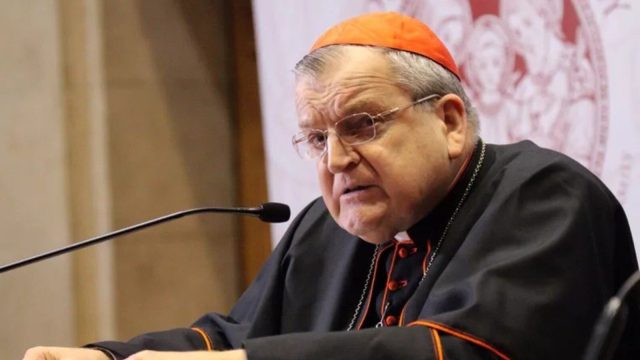
Cardinal Raymond Burke has said that Catholics may raise legitimate objections to certain comments made by the pope. His remarks came on August 20, 2026, in a recent episode of a video series on the Seven Pilgrim Churches of Rome, produced by the Shrine of Our Lady of Guadalupe in La Crosse, Wisconsin.
In the first episode, on St. Peter's Basilica, Burke spoke about the pope's human nature and the confusion that certain papal statements can cause among the faithful. He said there has been "a considerable amount of controversy surrounding certain statements and actions of the pope," which has left some people confused.
Distinguishing doctrine from informal remarks
Burke said that while the pope holds an office instituted by God as Vicar of Christ on earth, he is also a human being who can speak informally. "If the pope makes a spontaneous comment to a journalist, this is not the doctrine of the faith," he said, adding that the faithful have the right to object to such statements without rejecting papal authority.
Popes have historically been careful in their public statements to avoid confusion between their personal opinions and the official teaching of the Church, Burke said. "In the past, popes were very reluctant to speak. They spoke very little because they did not want the faithful to be confused about their personal ideas and what, as head of the Apostolic College, they would proclaim," he said.
Criteria from Vatican II
On what the Church teaches about papal statements, Burke cited the Second Vatican Council, which holds that the authority of a pope's statements depends on their content, intention and context, and on their relation to established Church teaching. In informal settings, he said, the pope is responding pastorally and is not formally defining doctrine.
The faithful are therefore not obliged to give the assent of divine faith to such comments, though they should interpret them with respect and charity and, as far as possible, in continuity with Catholic doctrine. Where a pope's statements objectively contradict established Catholic teaching, Burke said, the faithful may recognize the contradiction and, if necessary, make a respectful public objection or ask for clarification.
Respect for the office of St. Peter
Burke said respect for the office of St. Peter must be maintained even when objections are raised. "We must never lose respect for the office of St. Peter, the office conferred by Christ himself. Christ willed this. It is divinely willed for the life of the Church that St. Peter exist as that firm and principal foundation of the unity of the Church," he said.
That foundation has endured since the time of Christ, he said, even though some popes have not carried out their ministry worthily. He said that, like all the faithful, the pope is subject to divine Revelation and does not act as an arbitrary ruler but as a servant of the Word of God and a guardian of the faith the Church has received.
The series also features Father Chad Ripperger and Sean Pilcher, with narration by David Bates. In his closing reflection, Bates said that despite St. Peter's humanity and weaknesses, Christ chose him as the foundation of the Church: "The pilgrim who kneels here stands in the place where fragility and faith meet, where God builds his Church out of broken stones."