Pope Leo XIV urges Oxford's Oriel College to renew its Catholic identity
Receiving a delegation from Oriel College, Oxford, on its 700th anniversary, Pope Leo XIV pointed to St. John Henry Newman as a model of scholarship joined to faith and called on the college to renew its Catholic roots

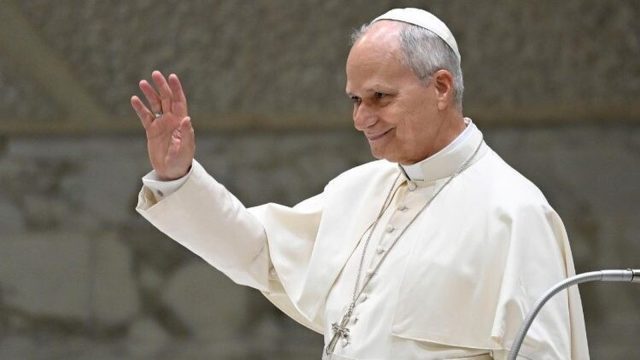
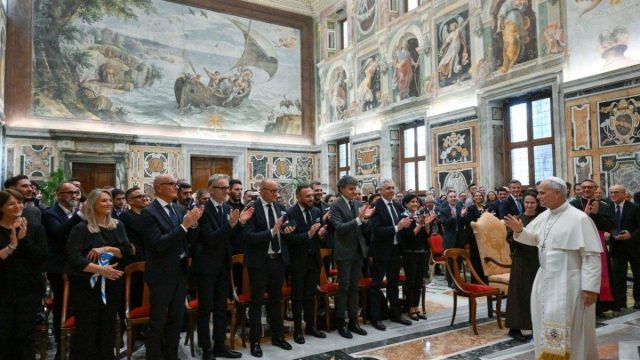
Pope Leo XIV received a delegation from Oriel College at the University of Oxford on September 4, 2026, in the Consistory Hall of the Apostolic Palace. In his address, the pope stressed the relevance of St. John Henry Newman's thought for education today, saying that "the value of education is measured by human dignity."
Leo XIV spoke of Oriel's "long and illustrious history" and of the many changes it has passed through in 700 years. Despite those changes, he said, the college has kept its Christian identity, and its anniversary is a providential opportunity to celebrate its Catholic roots, which go back to its foundation as the "College of the Blessed Virgin Mary" in the 1320s.
Catholic identity as institutional foundation
The pope said that Catholic identity is essential to the role Oriel plays as an academic community and a community of faith in the modern university. "Oriel is not only an academic institution, but a true community of faith and scholarship in its deepest sense," he said. "This identity is key to what has made and can continue to make Oriel a point of reference in Catholic education worldwide."
He urged the college to look to the future with renewed confidence, building on its past contributions. "The College can thus look with confidence to its past contributions as a sure foundation and guide for its future efforts," he said. Oriel's pilgrimage to Rome for its 700th anniversary, he said, comes at a providential moment for the Catholic Church and for Christian education in universities.
Newman: faith and reason inseparable
The pope presented Newman as a model of scholarship, a man who showed that faith and reason cannot be separated. Newman was a member of the college for more than 20 years before his conversion to Catholicism in 1845. During that time he was a fellow and served as a chaplain and as vicar of the Anglican parish church in Oxford.
"His religious convictions were rooted in his personal relationship with God, while his academic work was both sublime and eminently practical," Leo XIV said. Newman was proclaimed a Doctor of the universal Church and named co-patron of the Church's educational mission alongside St. Thomas Aquinas.
Catholic education as formation of the whole person
Newman's approach to education was another point the pope raised during the audience. "Newman's thought is particularly relevant, since it proposes a Christian formation that embraces the whole person and measures the value of education according to human dignity, justice and the capacity to serve the common good," Leo XIV said.
He called on Oriel's members and fellows to "seek the truth with courage and promote this integral vision of the human person." Their educational work, he said, can "genuinely make possible a 'heart to heart' encounter with your brothers and sisters, and especially with our Lord Jesus Christ, who is the way, the truth and the life."
Artificial intelligence and human dignity
The provost of Oriel, Lord Mendoza, thanked the pope for the audience. He referred to Leo XIV's encyclical Magnifica Humanitas and praised its comprehensive approach to artificial intelligence, which he said must be "governed toward human dignity, the common good, solidarity and justice." Mendoza said Oriel seeks to maintain "a small but resilient defense of human judgment and human presence" in a university setting facing growing challenges from the rapid automation of teaching and student assessment.
Newman: from Oxford to Rome
Newman was received into the Catholic Church in 1845, after resigning his position at Oriel College. He was created a cardinal in the consistory of May 1879 and held that rank until his death in August 1890. Benedict XVI beatified him in Birmingham in September 2010, and Pope Francis canonized him in 2019. He spent his last years at the Birmingham Oratory.
The pope closed his address with an exhortation to the delegation: "Seek the truth with courage and promote this integral vision of the human person. Entrust yourselves and the future of the College to the inextinguishable light of the world, so that you too, like Our Lady, may reflect his glory to the world."