Pope Leo XIV warns against reducing faith to 'mere habit' at Sunday Angelus
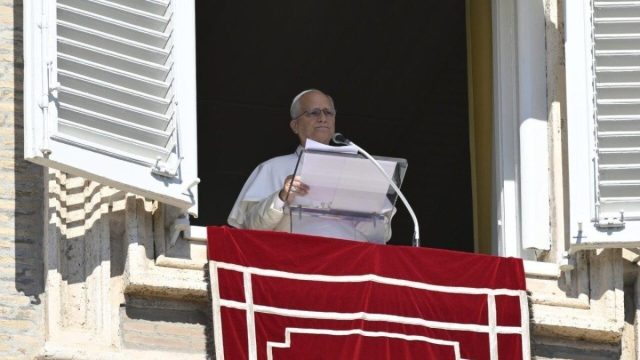
At the Angelus on Sunday, August 23, Pope Leo XIV told the faithful in St. Peter's Square that faith has to be rediscovered continually and turned into concrete decisions. He also prayed for Congo, the Central African Republic and central Italy

Pope Leo XIV has warned against turning Christian faith into a "mere habit" and called on believers to ask themselves again who Jesus Christ really is in their lives. At the Angelus on Sunday, August 23, the pope said faith needs to be rediscovered and translated into concrete decisions.
Speaking from St. Peter's Square, Leo XIV based his reflection on the passage in the Gospel of Matthew in which Jesus asks his disciples who they say he is. The question does not belong only to the past, the pope said, but is put directly to every Christian: "Who is Jesus, truly, for me?"
"Faith is not something given to us once and for all"
Leo XIV noted that the twelve apostles had already shared much of Jesus' life and ministry when he asked them that question. Even so, Christ did not take for granted that his disciples truly knew him or that they had understood the mystery of the Kingdom of God.
After asking them what people were saying about him, Jesus turned to the Twelve: "But who do you say that I am?" Leo XIV said this remains "a fundamental question for disciples of all times" and for each believer.
"Faith is not something given to us once and for all."
The pope said Christians need to "continually rediscover the face of Christ and his Gospel," to go deeper into his message and to renew the decisions of their own lives so that they match what they profess.
That path, he said, makes it possible to overcome one particular temptation: assuming that everything about the faith is already known, and ending up living it out of inertia.
"We can overcome the temptation to think that we already know everything and to reduce faith to mere habit."
Who is Jesus really in our lives?
Leo XIV then applied Christ's question to the daily life of each Christian: "Who is Jesus for me, and what does his presence mean in my life?" The question comes up above all in prayer and in meditating on the Gospel, he said, but not only there.
The same question arises when a believer encounters "the wounds and needs" of others, and in the relationships and situations that press hardest on the conscience. It is in daily life, Leo XIV said, that the place Christ really holds becomes clear.
The pope drew a basic distinction. Jesus can remain for someone simply "a great figure of history, who said and did important things," or he can be recognized as "the Christ of God," sent to bring people into the love of the Father and to transform both their lives and the world they live in.
More than what others have said about Christ
Leo XIV also asked Christians not to shut themselves inside their own "religious convictions and certainties," but to stay open to "an authentic relationship with Christ." He warned of another danger: settling for a faith received from outside without ever making it one's own.
A Christian can stop at what he has "heard," at certain shared ideas, or at what others have passed on to him, even when that was done with the best of intentions, the pope said.
But Jesus demands more, the pope said.
"Jesus calls us to give a personal answer, to know him more closely and to let ourselves be shaped by friendship with him through an ever new encounter."
That encounter can have unexpected consequences. Leo XIV said that truly following Christ can mean taking "unknown paths" and making decisions different from those a person had first imagined for his life.
Leo XIV asks the Church not to keep doing "what we have always done"
The pope did not limit his reflection to the spiritual path of the individual believer. He applied the same question to the life of the Church, and in particular to its pastoral decisions.
Here too, he said, there is a risk of thinking it is enough to keep repeating what has been done before.
"Sometimes we can think it is enough simply to keep doing things the way we have always done them."
Against that attitude, Leo XIV proposed that Christians individually and the Church as a whole keep asking what the Gospel requires now.
"Who is the Lord for me? Do I really know him? What does his Gospel ask of me today? What steps and what decisions am I called to take?"
Those questions concern the personal path of each believer, the pope said, but also the path of the Church itself and its pastoral choices.
Prayers for Congo, the Central African Republic and Italy
After the Angelus, Leo XIV turned to several international situations. He said he frequently remembers the Democratic Republic of Congo in his prayers, especially because of the spread of the Ebola epidemic, which is causing many deaths.
The pope encouraged the international community to respond in a way that also involves local communities in prevention work, to save lives.
He expressed his closeness to the people of the Central African Republic over the victims of the collapse at a mine in Zamboyé. Leo XIV prayed that the Lord would receive the dead, and he backed efforts to guarantee safety and respect for the law at mining sites.
He also noted that Monday marks 10 years since the earthquake that struck central Italy and affected regions including Lazio, Umbria and Marche. The pope prayed for the dead, their families and the communities affected, and asked that "faith and solidarity continue to sustain the work of reconstruction."