Victims' group COVITE criticizes Caritas over volunteer work for ETA prisoners
The Basque victims' association COVITE said it is "painful" that Caritas is providing work and volunteering to ETA prisoners, and said many victims of terrorism did not find the same support in the Church
COVITE, the Colectivo de Víctimas del Terrorismo (Collective of Victims of Terrorism), has criticized the part Caritas is playing in rehabilitation programs for prisoners from the Basque terrorist group ETA. In comments provided exclusively to Iglesia Noticias, Church Gazette's Spanish-language sister publication, the association contrasted that cooperation with the support many victims say they did not receive from parts of the Basque Church during the hardest years of terrorism.
"It is still painful to see how these Church institutions are in some way taking part in this whole situation, which we consider to be a fraud," the group said.
COVITE does not dispute that rehabilitation is part of the Church's work. It acknowledged that "the Church's teaching believes strongly in rehabilitation" and said it understands that Catholic institutions work in this field. Its objection is to the contrast between the attention some prisoners receive now and what it says many victims went through.
"We have missed similar behavior from these institutions toward the victims of terrorism," the association said.
The dispute over the Caritas programs
The dispute began after the Asociación Dignidad y Justicia (Dignity and Justice Association, DyJ) sent a letter to the president of Caritas, the Catholic Church's charitable organization in Spain. The association, chaired by Daniel Portero, raised concern about the participation of ETA members in Caritas's social action programs, the newspaper El Mundo reported.
The cases cited include those of Soledad Iparraguirre, known as Anboto, and Igor Solana. In the case of the former ETA leader, the activities have included tending a vegetable plot and parish gardens and helping people at risk of social exclusion. Solana, convicted of the murders of Antonio Muñoz Cariñanos, José María Martín Carpena and Luis Portero, has also taken part in volunteer activities organized by Caritas, according to the published information.
The activities take on significance within each prisoner's prison plan. Prisoners classified in the second grade can come under article 100.2 of the Prison Regulations. It allows their regime to be made more flexible and certain features of the third grade, the semi-open regime, to be applied when a specific treatment program justifies it.
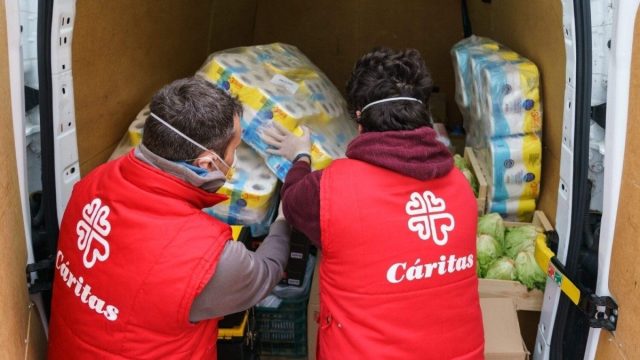
Caritas does not grant these prison benefits and does not decide whether prisoners move up a grade. But work or volunteering carried out with social organizations can form part of the rehabilitation programs that the competent authorities later assess.
It is that role that victims' associations have criticized, particularly in the case of people convicted of terrorism who, the groups say, have shown no real repentance for their crimes.
Dignidad y Justicia questions the legality
Dignidad y Justicia has gone further and argues that the prisoners' participation in certain programs could conflict with the Volunteering Law. The association points to the ban on people with certain criminal records that have not been expunged from serving as volunteers in programs whose beneficiaries have been or could be victims of offenses of the same kind.
That is the legal reading DyJ set out in its letter to Caritas. The association also called for tighter control over the activities ETA prisoners carry out within these programs and said some of them have neither repented nor asked their victims for forgiveness.
The dispute coincides with disagreement over Anboto's prison status. The prosecutor's office at the Audiencia Nacional, Spain's national court, has appealed her semi-liberty regime. It argues that the volunteer work she has done lacks the distinctive character and the treatment need required to justify applying article 100.2, according to El Mundo.
COVITE alleges 'tricks' to obtain semi-liberty
COVITE's position on Caritas is part of a broader criticism of the prison policy applied to ETA prisoners. The association told Iglesia Noticias it has spent years denouncing what it considers a fraudulent reading of some of the requirements that allow convicts to obtain semi-liberty.
Its focus is on repentance. COVITE accuses the Basque government of "rigging the requirement" by accepting letters from prisoners that, in its view, do not always match their later conduct.
"For years we have been denouncing the tricks being used by the Basque government, falsifying or rigging the requirement the law demands for access to these semi-liberty regimes, which is repentance for the crimes," the association said.
COVITE argues that a letter should not be enough to prove repentance when, it says, other conduct points the other way. Among other things, it cites the fact that some prisoners remain in an environment that continues to justify ETA's record, presents them as "political prisoners" and demands their release.
For victims, the group said, this creates "a sense of injustice and humiliation." COVITE said the rule of law should guarantee victims' right to justice, and accused the Basque government of using "tricks to get the murderers out of prison as soon as possible."
Caritas's role in the prisoners' plans
COVITE draws a distinction between that criticism of the Basque government's prison policy and the role of the organizations that provide activities for prisoners. It is on the second point that it places Caritas.
Beyond the argument over how repentance is proved, the association told Iglesia Noticias, these processes involve other practical elements that require the prisoner to be able to carry out an activity outside prison.
"Caritas, among other organizations, is offering these prisoners work or volunteering," it said.
For COVITE, the Catholic organization's involvement cannot be looked at in isolation from the process it forms part of. That is why it calls it "painful" that a Church institution provides activities that may end up being weighed within the plans that give these convicts greater access to semi-liberty.
The association acknowledges the Church's commitment to rehabilitation and does not deny that it can work with people serving sentences. The problem, in COVITE's view, arises when that willingness toward prisoners is compared with the attention given to those who suffered terrorism directly.
'We have missed similar behavior toward the victims'
This is where COVITE directs its main criticism at Church institutions. The association said many victims of terrorism have spoken for years of their unhappiness with the attitude they encountered in certain Church circles in the Basque Country during ETA's years of activity.
COVITE said the criticism cannot be extended to the whole Church and acknowledged that there were exceptions, people who supported victims. But it said that support was not what most of them experienced.
"Many victims have complained that they did not find comfort or support from, not the whole Church, but from a majority part of it in the Basque Country. There have been exceptions, and that is greatly appreciated," the association said.
That memory makes the current cooperation between Caritas and ETA prisoners harder for the group to accept. "To see that such support was not the norm and that now they are, in some way, taking part in this whole fraud, is painful," COVITE said.
Respect for the victims
Rehabilitation is part of the prison system and has traditionally been one of the areas in which the Church works. The question raised by the victims' associations is how to do that work without setting aside recognition of the harm done or support for those who suffered terrorism directly.
COVITE said the willingness now shown toward some prisoners contrasts with the experience of victims who turned to Church institutions for support at some of the hardest moments of their lives.
"We would have liked a similar attitude when many victims, looking for comfort and help, turned to the Church in the Basque Country at very difficult moments and did not find that same attitude," COVITE said.