Catholics and Public Life Congress to take up Hispanidad at November meeting in Madrid
The 28th Congreso Católicos y Vida Pública, organized by the ACdP and the San Pablo CEU university foundation, will be held November 13 to 15, 2026 in Madrid around the theme of the shared faith of Spain and Hispanic America
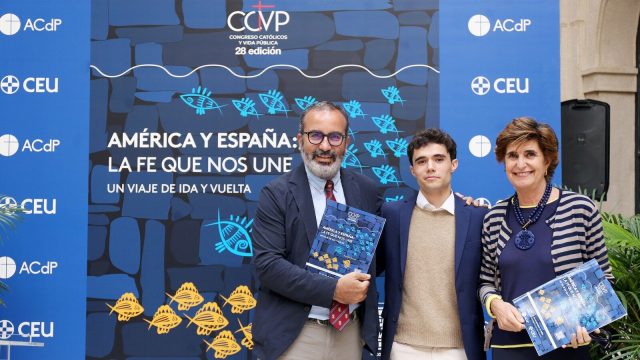
The Asociación Católica de Propagandistas (ACdP, Catholic Association of Propagandists) and the Fundación Universitaria San Pablo CEU presented the 28th Congreso Católicos y Vida Pública (Catholics and Public Life Congress) this morning. The congress will be held November 13 to 15, 2026 at Universidad CEU San Pablo (Julián Romea, 23, Madrid). Its theme is "Spain and Hispanic America, the faith that unites us, a round trip," which sums up this year's central proposal: to examine the historical, institutional and spiritual connection between the two continents.
A tangible reality, not nostalgia
The congress director, María San Gil, and the ACdP national secretary for communication, Pablo Velasco, presented the manifesto that opens the call for participation. Velasco said the chosen theme "reflects the importance of faith in our shared history and how essential faith is to our common present."
The manifesto states that "Hispanidad is not a hypothesis, nor is it nostalgia: it is a fact." It describes Hispanidad, the shared Spanish-speaking world spanning Spain and Hispanic America, as "a community of affections and interests, forged by history," sustained for more than 500 years by institutions with no equivalent in any international treaty.
The document lists those institutions: "town councils that bear twin names on two continents, universities that have shared an academic community since the 16th century, dioceses and parishes that pray in the same language." It adds: "None of this is artificial. None of this has to be invented."
The presentation comes at "a demanding moment for Western society," according to the text, which says Hispanidad "has passed through wars, independence movements and crises of every kind without losing its cohesion," because its foundation is historical and institutional rather than tied to the circumstances of the moment.
The foundation: Isabel la Católica and the law
The manifesto gives a central place to Isabel la Católica, Queen Isabella I of Castile, as the founder of this civilization. It says that "Isabel la Católica did not set a promise in motion: she set a civilization in motion." Her will, the text notes, ordered that indigenous people be treated "as free persons and not subject to servitude," setting a standard it calls unique in modern history.
"No other power in modern history legislated about itself in that way from the outset," the document says. Two institutions grew out of that founding act, and the manifesto presents them as pillars of Western thought.
The first is the Laws of the Indies, which the manifesto calls "the most extensive body of law ever issued by a power to limit itself." The laws grew out of Isabel's will and represent a commitment to regulating imperial power itself.
The second is the School of Salamanca, where Francisco de Vitoria, a central figure in the manifesto, set out "a century before anyone else in Europe, the principles of international law." The document says that "this is not a scholarly curiosity: it is our genealogy, and a reason for pride, not for archaeology."
The manifesto describes this inheritance as "the same thread that runs through Salamanca, the Laws of the Indies and the constitutions later written on both sides of the Atlantic."
The principles Hispanidad does not negotiate
The document sets out the values it says sustain this civilization: "the dignity of the human person, the Greco-Latin inheritance that gave us reason and law, the Christian tradition." To these it adds "respect for law as a limit on power, civil liberties as the condition of a dignified life."
It also names an economic element: "a legal framework capable of protecting property, contract and initiative as engines of prosperity." These values are not imported, the text says: "they are our own values, and that is why we defend them as a matter of course."
The text adds: "not as an outside imposition." The document says Hispanidad was founded on principles that limited imperial power itself.
Demographic growth
The manifesto turns to the present reach of Hispanidad, which "speaks a language that is growing on two continents, with more than 600 million speakers." That gives it "a demographic projection that no other major Western project can show," the text says.
"It is not contracting: it is growing." The document attributes that growth to "the same institutional fabric as always: municipalities, universities, dioceses, parishes, hospitals, professional associations, businesses." Those institutions have shown "over half a millennium, a capacity to endure that no supranational organization has achieved."
The text contrasts five centuries of institutional continuity in the Hispanic world with the age of the main supranational bodies, none of which is more than a century old, and presents that contrast as evidence of long-term viability.
Faith as the foundation of public life
The third part of the manifesto turns to religion. Hispanidad "is not exhausted in the political sphere or in relations between governments and nations," it says, and defending and developing it requires "a deep change of attitude, a radical one if necessary."
It calls for "a cultural and moral dimension worthy of its history," and says that moral dimension requires recognizing that "faith has been one of the firmest foundations of that civilization."
Restoring faith "to the center of our public life is an essential part of the answer to the crisis the West is passing through," the document says. It quotes Pope Benedict XVI: "We must live as if God existed."
Faith is presented as a practical response to a real crisis in the West, which, according to the manifesto, has lost "some of the anchors that have sustained it for centuries."
Hispanidad as a competitive advantage
The document closes by arguing that "to lay claim to Hispanidad is not to look backward." It says: "It is time to stop treating as a minor legacy what is our greatest competitive and moral advantage in the world to come."
The manifesto sets out three elements in its conclusion: "Isabel la Católica founded it. Vitoria thought it. The Laws of the Indies wrote it." It adds that "500 years of shared institutions have sustained it." The responsibility now falls on the present generation: "It falls to us, quite simply, to be equal to what we have inherited and to make it grow."
The text ends with the phrase "together we are stronger," presented as both the starting point and the conclusion of its argument.
Art as an expression of the proposal
New this year, the congress held a visual identity competition among students at the CEU universities. According to the presentation note, the aim was for "students at the CEU Universities to illustrate the Congress."
The winner is Carlos Figuero de Miguel, a digital art student at the Campus de la Creatividad (Campus of Creativity) of Universidad CEU San Pablo. Figuero designed a poster built around fish, which he said are "inspired by Mayan art and Christian iconography."
Each group of fish represents one continent, standing for Spanish and Hispanic American societies. Figuero explained the symbolism: "from each school comes a fish; a fish that is restless to answer something much greater and much better." The individual pieces from each community move toward one another, "to end up meeting each other."
Students from Universidad CEU Cardenal Herrera also entered the competition.
Registration for the Congreso Católicos y Vida Pública is open. The full program for the November sessions is available on the event's official website.