Bishop of Barbastro calls for unity with Opus Dei at Torreciudad shrine
Bishop Ángel Pérez Pueyo called for communion between his diocese and Opus Dei at the pilgrimage festival of the Virgins of Ribagorza and Sobrarbe, held at Torreciudad amid tensions in the Church

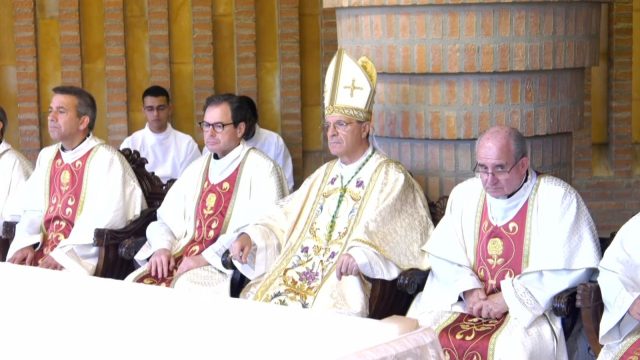
The Bishop of Barbastro-Monzón, Ángel Pérez Pueyo, called for unity within the Church on Saturday, September 5, 2026, during the pilgrimage festival of the Virgins of Ribagorza and Sobrarbe at the shrine of Torreciudad. The festival coincided with the 50th anniversary of the opening of the church, which was built by Opus Dei, and took place amid tensions between the diocese and the prelature. Those tensions led Pope Leo XIV to appoint the dean of the Tribunal of the Roman Rota, Msgr. Alejandro Arellano, as pontifical commissioner for the site.
The pilgrims went first to the original hermitage, accompanied by Pérez Pueyo. With the authorization of the pontifical commissioner, the image of Our Lady of the Angels, venerated there for more than a thousand years, was moved to the hermitage as an exception. During the ceremony those present placed ribbons in the hands of the Virgin, symbolizing the different Marian devotions that would together form a "mantle of communion."
Symbols of communion and diocesan unity
"No ribbon will disappear. No name will be erased. No village will have to stop being who it is. But all will be united in the same mantle," Pérez Pueyo said. In his prayer he asked the Virgin Mary to "unite what is separated, bring close what is distant, heal what is wounded." He also repeated that he would resign if the image of the Virgin of Torreciudad is not permanently installed in the old hermitage, saying he wanted his work as a shepherd to be worthy and exemplary.
After the prayer, the pilgrims walked in procession to the new church, praying the Rosary, and Pérez Pueyo celebrated Mass there. In his homily he said that "a mother has that mysterious ability to make room for everyone without taking away anyone's name, face or history."
Defense of popular piety and ecclesial roots
Pérez Pueyo stressed that the faithful must be able to draw near to their hermitages and their images. "We need to be able to say to Mary what perhaps we do not know how to say any other way," he said. "That is not a second-class faith. It is the simple piety of our people." The Church should not tear out those roots, he said, but purify them and make them fruitful for the Gospel.
He also praised the "evangelical fruitfulness of small things," referring to the original hermitage, and said that "what is small is not insignificant to God."
Recognition of Opus Dei and integration in the diocese
Pérez Pueyo devoted part of his address to the work of Opus Dei at Torreciudad. "All the good the prelature has done over these years is God's," he said. He said he hoped Opus Dei would continue its mission at the site and that Torreciudad would remain a center of Marian and family evangelization, fully integrated into the diocese.
He urged everyone to "add, multiply and dream together in communion within this particular Church of Barbastro-Monzón, of the Holy Universal Church."
He closed with a prayer to the Virgin Mary, asking her to "teach us to care for what is small without shutting ourselves in on ourselves. Teach us to bring together charisms, institutions, villages and sensibilities."