Former Athletic Bilbao player Óscar de Marcos delivers Domund address in Vitoria, Spain
The former soccer player told an audience at the Old Cathedral in Vitoria about his volunteer work with Salesian missionaries, and about a Salesian missionary in Togo who risked his life to save a girl accused of witchcraft
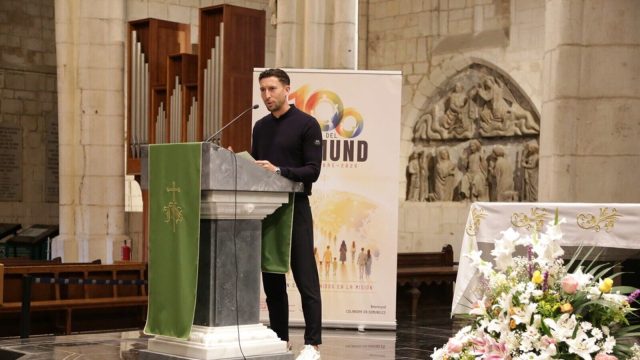
Óscar de Marcos, who played for Athletic Club de Bilbao and Deportivo Alavés, delivered the opening address for Domund 2026 this afternoon at the Old Cathedral in Vitoria, in Spain's Basque Country. Domund, the Spanish Church's annual campaign for World Mission Sunday, marks the centenary of the papal initiative this year.
Speaking to an audience gathered at the missionary exhibition marking the centenary, de Marcos described his volunteer work on three continents and reflected on the gap between being well known and being truly important.
He opened by admitting he felt out of place. "What am I doing giving a Domund address in front of people who have given years, and in many cases their whole lives, to helping others?" he asked. That contrast between public fame and real significance ran through the rest of his remarks.
De Marcos built his talk around a line he repeated several times: "Being known and fame are fleeting. But important people endure in the memory and in the heart." The turning point in his own life, he said, came when a student at a Salesian school asked him a blunt question: "You, who are a socially well-known person, how do you use that power you have to help others?" Rather than intimidating him, the question threw him completely, and it led him to ask the Salesian missionaries if he could volunteer.
At just 20 he traveled to Africa convinced he had something to offer. It turned out otherwise. "They were the important ones, and nobody knew who I was," he said. That reversal, he said, helped him understand something his great-grandfather had passed down and his father repeated generation after generation: "Love is like a fronton: the harder you hit the ball, the harder it comes back at you." The image, drawn from the walled court used in Basque pelota, summed up his experience, de Marcos said: "I think few phrases better explain what I felt in the experiences I lived through."
The act that changed the way he acts
De Marcos went on to tell the story of José Luis de la Fuente, a Salesian missionary who has spent more than 25 years in Kara, Togo, taking in children from the streets. During a meal with three priests and three volunteers, José Luis got an urgent phone call. He got up and ran out with one of the volunteers, and all they said was: "We'll tell you later."
That night they came back with a girl accused of witchcraft who was in immediate danger of being killed. The next day the whole team drove out in a van to confront the shaman who had made the accusation. That was when de Marcos understood how serious the situation was. "That girl was at risk of being killed. But I saw firsthand how José Luis faced that situation for a person he had not even known the day before. He was willing to risk his life to save another."
The courage he saw there stayed with him. "There are things other people do that change you, that make you think that somehow they also change the way you act," de Marcos said. Watching José Luis risk his life for a stranger was not a passing episode, he said, but the event that reshaped his understanding of what it means to be important.
Solidarity as something horizontal
De Marcos also returned to a lesson from the coach Marcelo Bielsa, taken from a line by the Uruguayan writer Eduardo Galeano, that had stuck with him: "Charity is vertical because it goes from top to bottom, while solidarity is horizontal because it happens between equals." The distinction, he said, was key to understanding his years as a volunteer.
Helping does not require grand gestures or crossing the world, he said. Often being there is enough. "Sometimes it simply means being next to someone, giving them time, listening to them or staying with them." He added something he said he had learned himself: "when you help, you receive much more than you give."
He closed with two acknowledgments. One was to José Luis, who for him embodies "everything I learned helping far from home." The other was to Antonio Mijangos, the pastor of Laguardia and a figure he looks up to in his own town, who represents "exactly the same thing: what it is to dedicate a life to helping those of us who are close by." Through those two names he extended his thanks to "all the missionaries and volunteers, men and women, who devoted their lives to making other people's lives better."