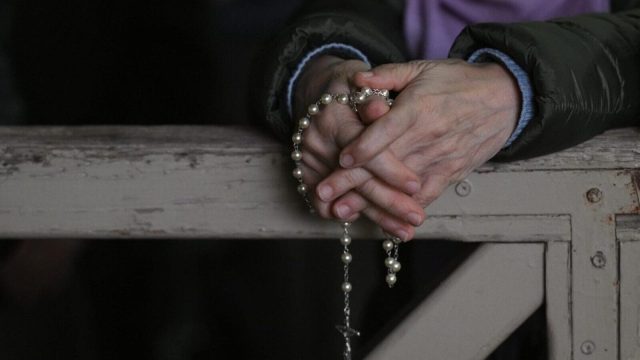
Pope John Paul II pointed to the Cross as God's answer to human suffering
In his 1984 letter Salvifici Doloris, Pope John Paul II wrote that not all suffering is punishment for sin, that the innocent suffer, and that the answer to suffering is found in the Cross

Pope John Paul II took up one of the oldest human questions in Salvifici Doloris: why do we suffer? In the 1984 letter, the pope wrote about the origin, the purpose and above all the meaning of human suffering.
The question man ends up asking God
That "why?" leads John Paul II to a further question: "Why evil? Why is there evil in the world?" The two questions are linked in Salvifici Doloris, because suffering is for man an experience of evil. The pope wrote that man suffers when he experiences an evil, and so asking about the meaning of suffering leads to asking about the reality of evil itself.
When he looks for a final explanation, man does not address the question only to the world or to those around him, but to God. "Man does not put this question to the world, even though it is from the world that suffering often comes to him, but he puts it to God as the Creator and Lord of the world," John Paul II wrote. At that point the question becomes harder still: how is suffering to be understood by someone who at the same time believes in a Creator who is good and just?
John Paul II acknowledged the conflict that can arise. If the existence of the world leads man to consider the wisdom, power and greatness of the Creator, evil and suffering seem able to darken that image. The difficulty deepens before a reality the pope stated bluntly: the existence of "so much suffering without any fault and so many faults without proper punishment." Innocent people suffer while certain faults appear to go unpunished, and that experience can change man's relationship with God and lead, he warned, "to the very denial of God."
But John Paul II did not hold that man should keep the question silent. He can put it to God "with all the emotion of his heart and with a mind full of dismay and anxiety." Suffering can produce incomprehension and even conflict with God, but the question still has someone to whom it is addressed. "God expects the question and listens to it," the pope wrote.
Job and the suffering of the innocent
To enter the problem, John Paul II turned to the Book of Job, which he described as one of the principal expressions of the question of the suffering of the innocent. Job is presented as a just man who, with no fault to explain what has happened, loses his property, his children and finally his health. His friends try to find an explanation that fits what has happened into the order of justice: if Job suffers in this way, he must have committed some sin.
The friends' reasoning rests on a conviction that John Paul II did not reject entirely. If God is just, moral good and evil have consequences; the conscious and free transgression of the moral law is a fault, and punishment makes sense when it is related to that fault. The problem comes when the link between fault and punishment becomes a rule for interpreting every case of suffering. Job's friends try to convince him that, since such misfortune has struck him, there must be a fault that justifies it.
Job knows he has not done what they are trying to convince him of. The outcome of the story matters for John Paul II: God himself reproaches the friends for their accusations and recognizes that Job is not guilty. From this the pope drew a conclusion: "It is not true that all suffering is a consequence of a fault and has the nature of a punishment." The existence of suffering does not permit the automatic conclusion that the person suffering is receiving from God the penalty due to his sins.
The case of Job brings a harder reality into the reflection: suffering can also reach the innocent. "His is the suffering of someone who is innocent," John Paul II wrote, adding that it "must be accepted as a mystery, which the individual is unable to penetrate completely by his own intelligence." The Book of Job breaks a too simple answer to the problem of pain: not all suffering can be explained through the relation between sin and punishment.
In the biblical account, Job's suffering has "the nature of a test." Satan casts doubt on his righteousness and argues that his fidelity to God is due to the goods he has received; if these disappear, Satan says, Job will end by cursing God. The test shows the opposite. John Paul II did not turn this particular explanation into a universal answer for all suffering. What Job shows unmistakably is that "there is suffering without guilt."
Even after Job's experience, the question remains open. "The Book of Job poses in an extremely acute way the question of the 'why' of suffering; it also shows that suffering strikes the innocent, but it does not yet give the solution to the problem," the pope wrote. Job makes clear that a person cannot be judged morally by the fact that he suffers, but he does not yet lead to the ultimate meaning of human suffering.
A mystery the intelligence cannot fully explain
John Paul II found a further dimension in other Old Testament texts. In certain cases suffering can appear as a call to conversion. Punishment would then not only return one evil for another, but could serve "the rebuilding of goodness" in the person who suffers. In this view, correction has a purpose that is educational: it seeks to let the person return to the good and to establish it again in himself and in his relations with others.
This dimension does not make suffering fully explainable either. Job remains a reminder of the suffering of the innocent. John Paul II did not construct a formula for determining the specific cause of every illness, loss or tragedy. As he went on, he acknowledged the limit that human intelligence reaches on this question.
"Suffering is always a mystery; we are conscious of the insufficiency and inadequacy of our explanations."
John Paul II did not promise an explanation capable of making every particular suffering intelligible. He had already acknowledged that there is pain without fault, that the innocent can suffer and that human explanations fall short before the mystery. The search for the "why" has to continue from another direction.
From justice to love
At this point John Paul II turned from the ground of justice, where the effort is to establish a relation between fault, punishment and reparation. He directed attention to what he called the ultimate source of the meaning of everything that exists: the love of God.
"In order to perceive the true answer to the 'why' of suffering, we must look to the revelation of divine love, the ultimate source of the meaning of everything that exists."
John Paul II wrote that love is "the richest source of the meaning of suffering," even though that meaning remains a mystery. Man does not reach it simply by reasoning. It is Christ who, according to the pope, "makes us enter into the mystery and helps us to discover the 'why' of suffering," to the extent that we are able to grasp "the sublimity of divine love."
To explain this revelation, John Paul II dwelt on Christ's words to Nicodemus: "For God so loved the world that he gave his only Son, so that everyone who believes in him may not perish but may have eternal life." There the pope found the center of God's saving action. The Son is given so that man may not be lost and may have eternal life; God's love enters human history to confront evil at its deepest roots.
This also widens the problem. For John Paul II, Christ's mission does not consist simply in freeing man from particular temporal sufferings. The definitive evil is the loss of eternal life and separation from God. The salvation accomplished by Christ reaches that root and opens to man the hope of eternal life.
When John Paul II looked for the answer to the meaning of suffering, he found in love a key that justice alone could not provide. "Love is also the fullest source of the answer to the question of the meaning of suffering," he wrote.
Christ enters human suffering
The answer John Paul II presented does not remain in words. Christ enters personally into the world of suffering. During his public life he comes close again and again to those who suffer: he heals the sick, consoles the afflicted, feeds the hungry, gives sight to the blind and health to people affected by various illnesses. The pope wrote that Christ was especially sensitive to every human suffering, of body and of spirit.
Christ does not only meet the suffering of others. He experiences it himself. John Paul II recalled that Jesus knows where he is going: he knows he will be seized, humiliated, struck, spat upon, condemned, crucified, and that he will die. His suffering does not appear as an unexpected event he tries to escape, but as a reality toward which he moves consciously in fulfillment of his mission.
The pope summarized this in two statements: "Christ suffers voluntarily and suffers innocently." The question that had appeared in Job takes on a new depth. Christ is innocent and yet suffers. In him the question of suffering without guilt appears again, now within the central event of Christian salvation.
The Passion gathers different dimensions of suffering. John Paul II recalled the blows, the humiliations and the crucifixion, and he dwelt as well on the spiritual depth expressed in the words spoken from the Cross: "My God, my God, why have you forsaken me?" Christ enters to the depths of the human experience of suffering and of the "why?"
John Paul II's answer is in the Cross
It is in the Passion that John Paul II placed the turning point of his reflection. Human suffering reaches its greatest depth there and at the same time enters something new. "Human suffering has reached its culmination in the passion of Christ. And at the same time it has entered into a completely new dimension and a new order: it has been linked to love," he wrote.
John Paul II did not present suffering as a good in itself. From the beginning of Salvifici Doloris he had related it to the experience of evil. What he saw as new in Christ is that love enters into that experience and makes it possible for a good to come out of suffering. On the Cross, out of Christ's suffering comes what the pope called "the supreme good of the Redemption of the world."
The Christian answer does not remove the mystery that appeared at the outset. John Paul II did not end by explaining why each particular suffering happens, nor did he say that man can always know its cause or purpose. He rejected the idea that all pain is a punishment, acknowledged the suffering of the innocent, and admitted the "insufficiency and inadequacy" of human explanations.
What he did was direct the question toward Christ. The answer to the meaning of suffering is discovered, according to John Paul II, in the love of God shown in the Son who enters human suffering voluntarily and innocently, goes as far as the Cross, and brings out of it the good of the Redemption.
"Love is also the fullest source of the answer to the question of the meaning of suffering."
After going through man's suffering, the question put to God, the drama of Job, the pain of the innocent and the limits of human intelligence, John Paul II carried the "why?" to the Cross of Christ. That is where, according to Salvifici Doloris, God has given man his answer:
"The answer to this question has been given by God to man in the cross of Jesus Christ."