Spanish physicist David Jou calls God the foundation of reason, not an irrational refuge
Barcelona physicist David Jou i Mirabent told an audience at the University of Navarra in Pamplona, Spain, that the concept of information can bridge science and faith in the search for meaning
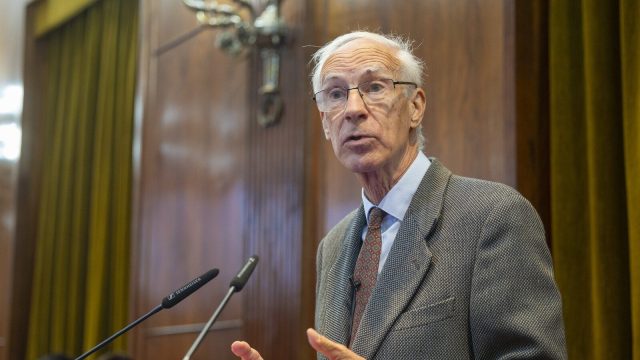
David Jou i Mirabent, professor of condensed matter physics at the Autonomous University of Barcelona, delivered the eighth Mariano Artigas Memorial Lecture on October 14 in Pamplona, in northern Spain. The lecture was organized by the Science, Reason and Faith Group (Ciencia, Razon y Fe, CRYF) of the University of Navarra. Raúl Antón, the university's vice rector for faculty, presided. Jou built his talk around a single argument: "God is not an irrational refuge for what we do not know, but the foundation of reason."
He proposed an approach to the dialogue between science and faith: bringing in the concept of information as a bridge between the two disciplines. Contemporary science cannot rest on matter and energy alone, he said. It also needs information, and that addition opens real possibilities for an integrated understanding of reality.
The big questions on creation and the soul
Jou went through several questions shared by science, philosophy and theology, grouped as four on creation and four on the soul. Among them: Is the world contingent or necessary? Does it have a purpose or meaning? What is the origin of the difference between inanimate matter and life? What of the person can survive death?
None of these questions can be answered from a single discipline, he said. They require a genuine dialogue between different fields, each able to recognize its own limits and to learn from the others.
Information: quantitative, structural and semantic
Jou set out three dimensions of information that underpin his proposal: the quantitative, tied to measurement; the structural, tied to organization; and the semantic, tied to meaning. The third allowed him to pose a question that he said science cannot answer: "What does the universe exist for?"
As a hypothetical answer, he offered something that goes beyond the strictly scientific: "It may be that the universe exists for love," understood as recognition, benevolence and cooperation. He said this showed how the semantic dimension of information makes it possible to ask questions of deep existential reach.
Toward an open worldview
Jou closed by saying he hoped the concept of information would contribute to a "more open and flexible worldview" that favors dialogue between science and faith. That dialogue cannot stay inside academic circles, he said: "The most important thing is not to limit this dialogue to specialists, but to try to pass it on to the public."
The event opened with remarks by Santiago Collado, director of the CRYF and dean of the Ecclesiastical Faculty of Philosophy, who described the group's work and the framework of the Mariano Artigas Memorial Lectures. Javier Sánchez Cañizares, a member of the CRYF and a researcher at the Institute for Culture and Society (ICS), introduced the speaker. They were joined at the head table by professor Francisco Gallardo, who attested to the selection of the speaker in November 2025.