
Cardinal Cupich to honor donor who funded abortion groups, drawing protest
The Archdiocese of Chicago will present its first Nostra Aetate award to businessman Michael Sacks, whose giving to abortion providers and access funds exceeds $1 million, drawing a protest from Illinois Right to Life, which says the award breaks the US bishops' norms
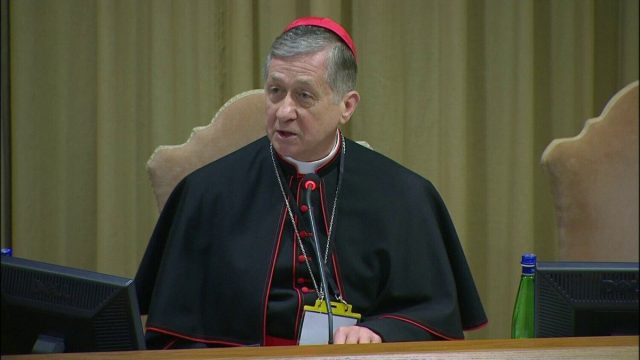
Cardinal Blase Cupich, the archbishop of Chicago, will present the archdiocese's first Nostra Aetate award to billionaire businessman Michael Sacks on Thursday, October 29, at the annual Seminary Salutes Rerum Novarum dinner, a fundraiser for the formation of seminarians at Mundelein Seminary. The decision drew a public protest from the pro-life group Illinois Right to Life, which accused the cardinal of scandalizing the faithful by honoring someone who has financed abortion on a large scale.
Sacks and abortion funding
Sacks is chairman and chief executive of the investment firm GCM Grosvenor, heads the Sacks Family Foundation and sits on the board of the Obama Foundation. His family foundation has given to education, the arts and veterans, among other areas. Public records show a $500,000 contribution to Planned Parenthood of Illinois between 2020 and 2022, with no restriction on the use of the money, and a further $600,000 to the Prairie State Access Fund, an initiative launched by Illinois Gov. JB Pritzker, a Democrat, to bolster abortion access in the state and counter federal restrictions. Recipients of that fund include Planned Parenthood of Illinois and the Chicago Abortion Fund. His giving to organizations that promote abortion therefore comes to more than $1 million.
The cardinal's response
In a statement posted October 26 on the archdiocese's website, Cupich described Sacks as "a highly respected leader in Chicago and in the Jewish community" and defended the award by invoking Nostra Aetate, the Second Vatican Council's declaration on the Church's relations with non-Christian religions. The statement said that "honoring a leader, formed by his Jewish faith, for the gifts he brings to society through his leadership, his generosity and his talent, recognizes this shared divine heritage, distinct from specific contemporary political or doctrinal disputes." It added that the recognition does not imply endorsement of every position the recipient holds, and that dialogue "cannot take place if respect depends on complete agreement on Church doctrine or politics." The statement makes no reference to abortion or to the funding of Planned Parenthood.
Rather than answer the objections about abortion, Cupich addressed the criticism as if it concerned Sacks's Jewish faith. He said the archdiocese had been criticized for honoring someone who does not share the Church's central beliefs, "chief among them the divinity of Jesus Christ," and warned that refusing to honor or engage with Jews because of their religious or political positions "can risk mirroring historical patterns of antisemitism through exclusion and intolerance."
Illinois Right to Life responds
Illinois Right to Life rejected that framing. Its president, Mary Kate Zander, said her organization is "the only one that has formally issued any kind of statement" about the award, and that its objection "has nothing to do" with Sacks's faith or ethnic background. She said the cardinal's statement "creates confusion" by suggesting the dispute is a response to antisemitism. None of the criticisms published by Illinois Right to Life refers to Sacks being Jewish.
Zander accused Cupich of shifting the focus: "He is distracting attention from the fact that this man is clearly an advocate for abortion on a very large scale," she said, adding that the cardinal "doesn't want the conversation to be about that" but about the recipient's faith and background. She also said she was concerned for Sacks's soul and called on the cardinal to take responsibility for holding those who receive Catholic honors publicly accountable.
Mary FioRito, of the Ethics and Public Policy Center, called it "completely fallacious" to present the objections as a rejection of Sacks's Jewish faith, and said the criticism concerns his financial and public support for abortion. Zander said it is hard for an institution to defend life credibly when it is at the same time honoring someone who has directed large sums to abortion providers.
USCCB norms
Illinois Right to Life also argued that the award violates the norms of the United States Conference of Catholic Bishops (USCCB). The document Catholics in Political Life, approved in 2004, states that "the Catholic community and Catholic institutions should not honor those who act in defiance of our fundamental moral principles" and that they "should not be given awards, honors or platforms which would suggest support for their actions." The Archdiocese of Chicago's own policy manual sets out the same standard, applicable to any entity under the archbishop's authority. The Catechism of the Catholic Church, at No. 2271, states that "since the first century the Church has affirmed the moral evil of every procured abortion" and that "this teaching has not changed and remains unchangeable."
Illinois Right to Life circulated a petition calling for the award to be withdrawn, which gathered nearly 4,000 signatures before the gala. The archdiocese did not respond, and the group organized a protest outside IBEW Local 134 on the day of the banquet. Zander, who is Catholic, said the main reason for the protest is "concern about the scandal caused by" the cardinal's decision, and accused the cardinal of "leading people off the right path and scandalizing the faithful."
The Durbin case
This is not the first such dispute involving Cupich. In September 2025, the archdiocese announced it would give Sen. Dick Durbin, an Illinois Democrat, a lifetime achievement award at the Keep Hope Alive benefit gala in recognition of his work on behalf of immigrants, despite his long record of support for abortion. Bishop Thomas Paprocki of Springfield, the diocese where the senator lives, publicly asked that the award be rescinded and wrote that Durbin's record made him unworthy of any Catholic honor. According to the organization CatholicVote, as many as seven US bishops asked the cardinal to reconsider. On September 30, Cupich said Durbin had declined the award. Unlike Durbin, Sacks is not a politician but a private donor, and this time Cupich answered the criticism in writing three days before the gala, without backing down.


