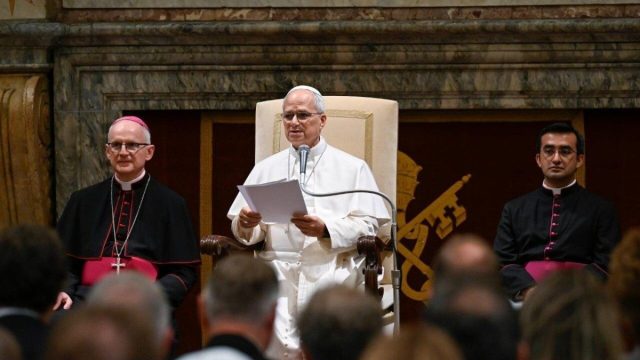
At Notre-Dame, Pope Leo XIV tells French clergy the Church cannot retreat from the world
Pope Leo XIV led evening prayer at Notre-Dame Cathedral in Paris on September 25, 2026, calling the bishops, priests, deacons and consecrated men and women of France to missionary conversion, unconditional welcome and love for the liturgy
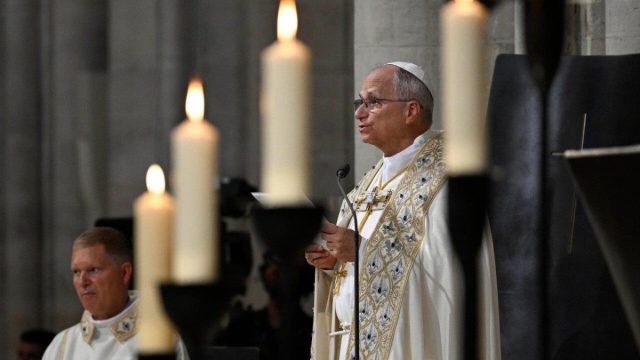
Pope Leo XIV led evening prayer at the Cathedral of Notre-Dame in Paris on Friday, September 25, 2026, seven years after a fire devastated the building. In his homily he addressed the bishops, priests, deacons and consecrated men and women of France, calling them to a radical missionary conversion and to understand the Church as a place of unconditional welcome.
A grief that was not only Catholic
The pope opened his homily by recalling the 2019 fire. "Seven years have passed since the whole world, holding its breath, watched the cathedral devoured by a terrible fire," he said. In that moment, he went on, "we looked up, bewildered, aware of human powerlessness in the face of the unforeseeable."
"That grief was not only that of Catholics, nor even of believers," he said. "In that dramatic hour we understood that Notre-Dame is much more than a monument. Everyone's part in its reconstruction and, today, the splendor of the result show that the heart of a people beats in this place."
The cathedral, he said, is "the vital center of a civilization," a place where "the past and the future embrace, and heaven and earth meet." The Church finds in Notre-Dame, he said, a reflection of its own mission in the world today.
The cross-shaped floor plan
The pope turned to the architecture of the restored cathedral. "The cathedral's cross-shaped floor plan, where stone and light merge, evokes the meeting of earth and heaven," he said. That geometry, he added, "gathers and orders the events of history, woven of human joys and sufferings."
The cathedral "holds together" the events of history in "a symbolic dynamic that builds a living language out of different expressions, integrating them into a unity," he said. He made the same point about the Church: it should integrate plurality into a communion that neither dissolves nor flattens differences but unites in diversity.
Public, private and Church institutions
The pope praised "the institutions, public, ecclesial and private, involved in the restoration of Notre-Dame" for having helped, "each with its own specific contribution, to reactivate the cultural, existential and spiritual paths that the cathedral offers."
The Church, he said, has understood its task "not only in terms of preservation, but also of creativity, making tradition live with the boldness of those who have faith and look toward Hope." He thanked the archbishop of Paris, his collaborators and the diocesan community for having "also devised a pastoral program of first proclamation and Christian initiation accessible to all."
The baptistery as an invitation
The pope pointed to the placing of the baptistery at the entrance of the restored cathedral. "The baptistery, placed at the entrance as a blessing and an invitation, is a sign of this," he said.
From rebuilding to missionary conversion
He then spoke directly to the pastors of France. "Let yourselves be inspired by what has happened here. Give priority to Evangelii gaudium," he said, referring to the apostolic exhortation in which Pope Francis set out the need for a "missionary conversion" of the Church.
He read to the assembly the passage from the Letter to the Galatians, "God sent his Son," and said the verb used by St. Paul "describes a real, historical event, and not ideal circumstances." Christians, he continued, "do not flee from complexity, because God himself has called them to follow his Son in a world already inhabited, already in motion, already marked by the miseries and the goodness of human beings."
A Church that goes out, not a refuge
The Christian community, the pope said, is not "a refuge in which to withdraw to protect itself from its own time." Instead, it "offers itself, like the ancient cathedrals, as a space of welcome, respect, revelation and meaning for all."
In this he identified "the strength of a living Church: to welcome the periphery that is already at its heart, to welcome those who are far away but who are in fact already close, to welcome the stranger in whom Christ is already knocking at the door." The Church's identity flows from the Incarnation, he said: a Church "always going out," never turned in on itself.
Missionary presence on the periphery
Widening his remarks from Notre-Dame to the whole of France, the pope called for a missionary presence spread across the country. "If Notre-Dame is a sign of this encounter in the heart of Paris, all the more can the other cities and regions of France, even the most peripheral and rural, be transfigured by a missionary presence that is simple and kind," he said.
"From the northern coasts to the Mediterranean, from the inland regions to the Overseas Departments, be a living Church, manifold and close to people," he said. He added that "poverty of means does not prevent mission, because it is God's grace that makes interior freedom and simplicity of life possible."
The pope said he looked "with confidence" to "the missionary presence of the lay faithful, who are the living vanguard of the Church at the crossroads of daily life."
Liturgy, the soul of the cathedral
He then turned to what he called the purpose of any church, Notre-Dame included. "Brothers and sisters, nor should we forget that the purpose for which this church was built, like every other church, is prayer and the praise of God," he said.
"The cathedral is not a stone shell meant to be admired: it lives from the sacred mystery celebrated within it. Deprived of liturgical action, it would lose its soul," he said.
The pope pointed to the placing of the altar at the center of the restored space. "The community that praises the Lord stands at the heart of the building, and visitors, even during the celebrations, walk around it and contemplate it," he said. In that arrangement the Church "appears as it is: a living organism, a community of believers."
Liturgy as a glimmer of hope
The pope placed the experience of the liturgy in the context of today's world. "Today more than ever we live in a time that seems deprived of fullness, depth and promise," he said. "The noble simplicity of the chant, the word and the liturgical gesture can be for many a glimmer of hope, an oasis of peace in a hyper-connected and noisy society."
In that experience, he said, "it is possible to experience the presence of the Author of the greatest love." The celebration of the liturgical year, of Sunday and of the feasts "also makes us contemporaries of Christ, attentive to the different moments of his life, given entirely to the Father for the world."
From that attention to the rhythms of the liturgy, he said, follows an ethical and political consequence: "Listening together to the Scriptures and prayer allow us to look at historical events in the light of God, making us more aware of our responsibilities, able to unmask unjust relationships of power and to preserve the seeds of justice and peace."
A charge to the bishops on liturgy
Speaking to the bishops, priests, deacons and consecrated men and women of France, the pope said: "To you who celebrate the Eucharist daily, I ask that you see to it that liturgical celebrations are always carried out with dignity and decorum, including where smaller communities gather."
He called on the pastors to be "conscious heirs of the Fathers and the Saints of the Church who, over the centuries, have handed on to us the deep meaning and the beauty of the liturgy." He cited the Second Vatican Council, "whose richness owes much to France."
"I urge all of you, bishops, priests, deacons and consecrated persons, to cultivate a genuine love for the liturgy and to be witnesses and servants of the prophetic, priestly and royal vocation of the whole people of God," he said.
Communion and unity as fruit of the Eucharist
The pope linked the Eucharist to wider social and ecclesial life. "Eucharistic joy takes hold and spreads wherever harmony is recovered, wherever dignity is reborn, wherever authority becomes service, wherever freedom makes its way again," he said.
He then spoke of the unity of the people of God. "This is the greatest gift we can share. Put communion with the Successor of Peter and with the Church before your personal sensibilities, so as to cultivate the unity of the people of God. Together we will be the prophecy that a reconciled world is possible."
The inner life of pastors
Addressing "you who have been called to follow Christ," the pope said: "I thank you for your response and your fidelity to the Lord. Never neglect that friendship, willed by the Lord, which is to be cultivated in personal prayer, the essential foundation of every vocation."
He quoted Madeleine Delbrêl, a contemporary French thinker: "Without prayer, we will not love God with love. We may be his servants or his fighters, or even his disciples; but we will be neither loving children of our Father nor friends of Jesus Christ."
"Your mission springs above all from that intimate relationship with the Lord, who waits for you there," he said. He urged the consecrated to "cultivate your interior life with the Lord in the school of the many saints who have gone before you, always drinking from the source of God's infinite love in silent prayer."
The open cathedral and the Church's motherhood
Closing his homily, the pope said: "In the heart of the city, the open cathedral is a sign of a community that praises the Lord and lives hospitality as the very form of its existence, so that everyone can feel at home."
He returned to Galatians: "God sent his Son, born of a woman, so that we might receive adoption as sons," and "if you are a son, you are also an heir."
To the "pastors and consecrated men and women of France," he said: "You are called to be the first guardians of this open house, living stones of a Church that hopes and does not fear the future. This cathedral has been reborn so that you may be reborn with it in a new impulse of holiness and daily mission."
He added: "In the midst of your people, be a transparent expression of the divine motherhood of the Church which, bearing witness to God's love, rebuilds and heals the human family."
Mary, guardian of French fidelity
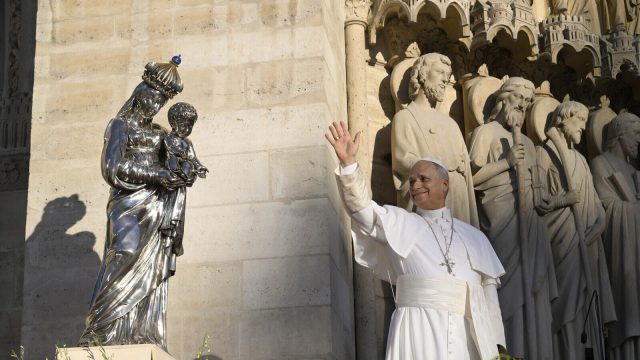
The homily ended with Marian devotion. "Let us lift our eyes to the 14th-century image of the Virgin and Child, which the fire did not reach and which shines again before us," the pope said.
His final prayer was: "May Mary, who bore the Word in her womb, guard your fidelity and be the star that guides the mission of the Church in France." He closed: "Holy Mary, Notre-Dame de Paris and Mother of the Church, pray for the French people, sustain their pastors and always walk at our side."